
Monday Memo
A Byte of Knowledge
Reaching for the strongest AI model on every task is like using a Ferrari to deliver pizzas.
Fable and GPT-5.6 Sol think the hardest, and they chew through your usage limit just as fast.
So a week of pointing them at easy work leaves you out of tokens the moment a real problem lands.
Most of what fills your day doesn't need that horsepower.
Reformatting a list, pulling quotes from a transcript, a lighter model like Sonnet or GPT-5.6 Luna clears it and barely dents your limit.
So keep the Ferrari in the garage until the job actually calls for it, like planning the grand strategy and outline of a VSL.
What requires the top models is your call, and it shifts from one project to the next.
But always make sure to match the model to the size of the job.
🚀 WATCH: How These AI Copy Bots Are Producing World-Class Sales Copy 50X Faster Than Even The "BEST" Copywriters On The Market…
(Plus… They Don't Get Sick, Miss Deadlines, Or Ask For Raises Either!)
Watch the full AI Copywriting Tell-All Video Here
Something to Ponder
We Asked – AI Answered
Our Question:
"Explain the difference between open source and closed source AI models. And show me both sides of the debate over which are better ultimately for the future of AI.Don't pick a winner yourself. Just show both sides of the argument.”
AI's Answer: Open vs. Closed AI -Who Gets the Keys? 🔑
Think of an AI model as a commercial kitchen. Its outputs are the meals; the weights are the chef’s learned instincts; training data is the ingredient history; and code is the kitchen process.
The debate is straightforward: who gets to inspect, modify, control, and profit from that kitchen?
🧩 Three Labels to Understand
Open-source AI
Under the Open Source Initiative’s definition, users must be free to use, study, modify, and share the complete AI system. That requires more than downloadable model weights.
Open-weight AI
Users can download and modify the trained weights, but the creator may withhold training data or development code and impose licensing restrictions.
Closed-source AI
The provider keeps the weights, code, and training process private. Customers access the model through an app or API, while the provider controls its rules, pricing, and upgrades.
Why the distinction matters: Models promoted as “open source” may technically be open-weight. Meta’s Llama 3.x, for example, does not meet OSI’s stricter open-source standard.

🌱 Why Open AI Appeals to Businesses
1. More competition
Startups can adapt existing models without depending entirely on a dominant provider. This can reduce vendor lock-in, increase bargaining power, and create pricing pressure.
2. Greater control
Businesses can host open-weight models on their chosen infrastructure and customize them for specific products, markets, or brand terminology.
For marketing teams, that could enable:
- Brand-specific content systems
- Private analysis of customer information
- Campaign tools less vulnerable to sudden API changes
3. Faster experimentation
Developers can inspect model behavior, test weaknesses, create specialized versions, add languages, and serve markets that larger providers may overlook.
4. Competitive performance
Stanford’s 2026 AI Index reported a gap of roughly 3.3% between leading closed-weight and open-weight models on Chatbot Arena Elo in March 2026. Supporters view that result as evidence that greater accessibility does not automatically mean dramatically weaker performance.
🎯 A Marketer’s Decision Guide
Favor more openness when you need:
- Deep brand or industry customization
- Local hosting and tighter data control
- Protection from vendor lock-in
- Better economics at high usage volumes
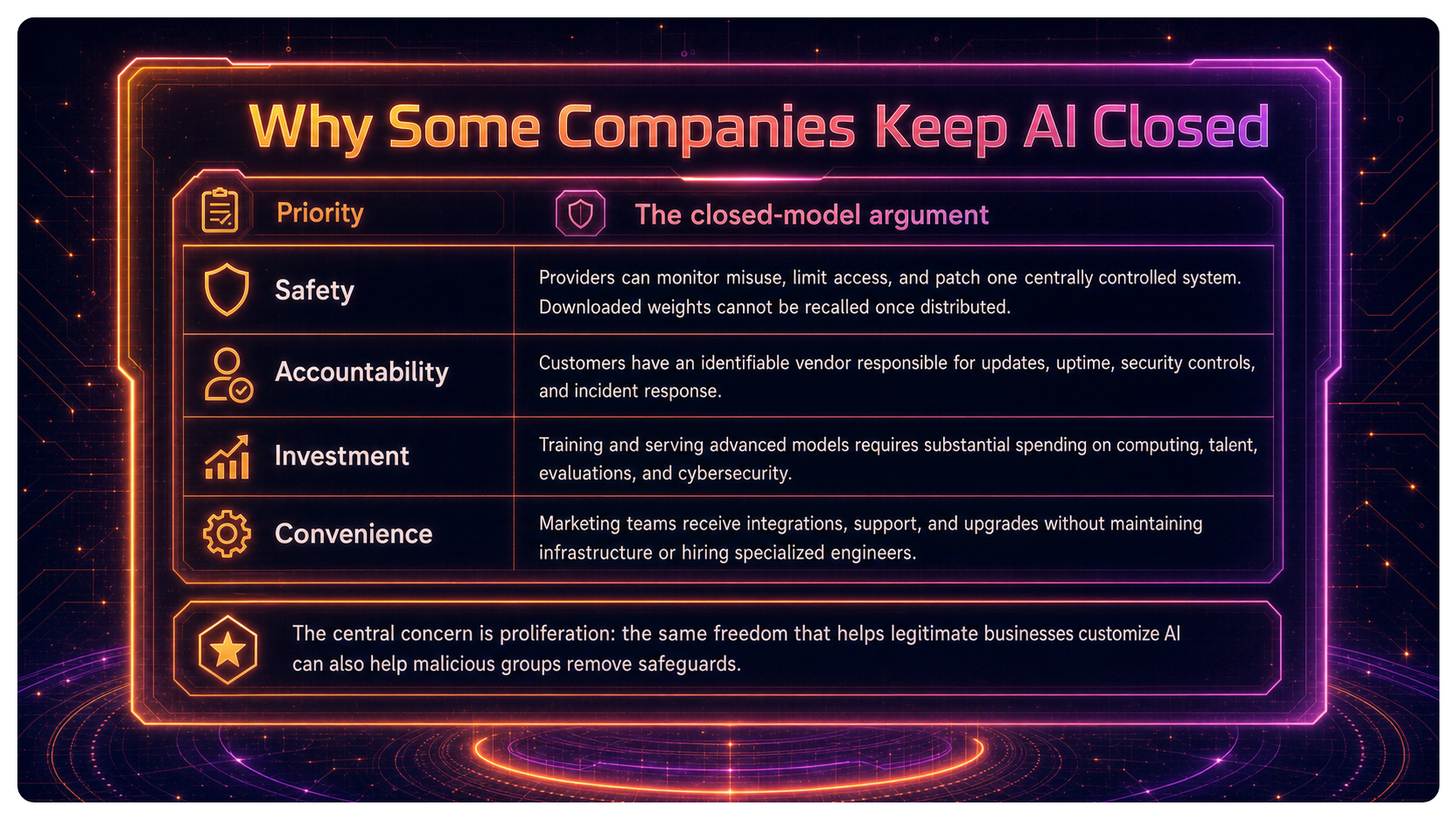
Favor a closed system when you value:
- Immediate deployment
- Managed security and maintenance
- Professional support
- Access to advanced capabilities without an internal AI team
Before signing an AI contract, ask:
- Who retains campaign and customer data?
- Can we export our customizations?
- What happens if pricing or usage policies change?
- Who is accountable when the model causes harm?
⚖️ The Real Debate
Open advocates fear concentrated control over pricing, access, speech, and innovation. Closed advocates fear irreversible access to powerful capabilities.
Both defend legitimate priorities: freedom to build and control over dangerous tools. AI’s future will likely combine both approaches, depending on the industry, application, and level of risk.

Thanks for reading the Monday Memo.
Until next time!
The AI Marketers
P.S. Help shape the future of this newsletter – take a short 2-minute survey so we can deliver even better AI marketing insights, prompts, and tools.
[Take Survey Here]
