
Need to Know News - August 22nd, 2026
In this week's Need to Know News edition:
🤖 Google now lets readers name "Preferred Sources" that get boosted in their AI answers... and suddenly winning that pick matters as much as rankin
🤖 Anthropic opened a free AI school... so you finally learn which jobs belong to AI and which should stay with you.
🤖 A new legal AI beats the big general models on their own turf at a quarter of the price... whose industry is next?
And a whole lot more!
Anthropic's Free AI Academy Teaches Judgment Over Shortcuts
Plenty of people use AI every day without anyone ever showing them how. Anthropic wants to close that gap with Claude Academy, a free set of courses aimed at how to work with AI, not which buttons to press.
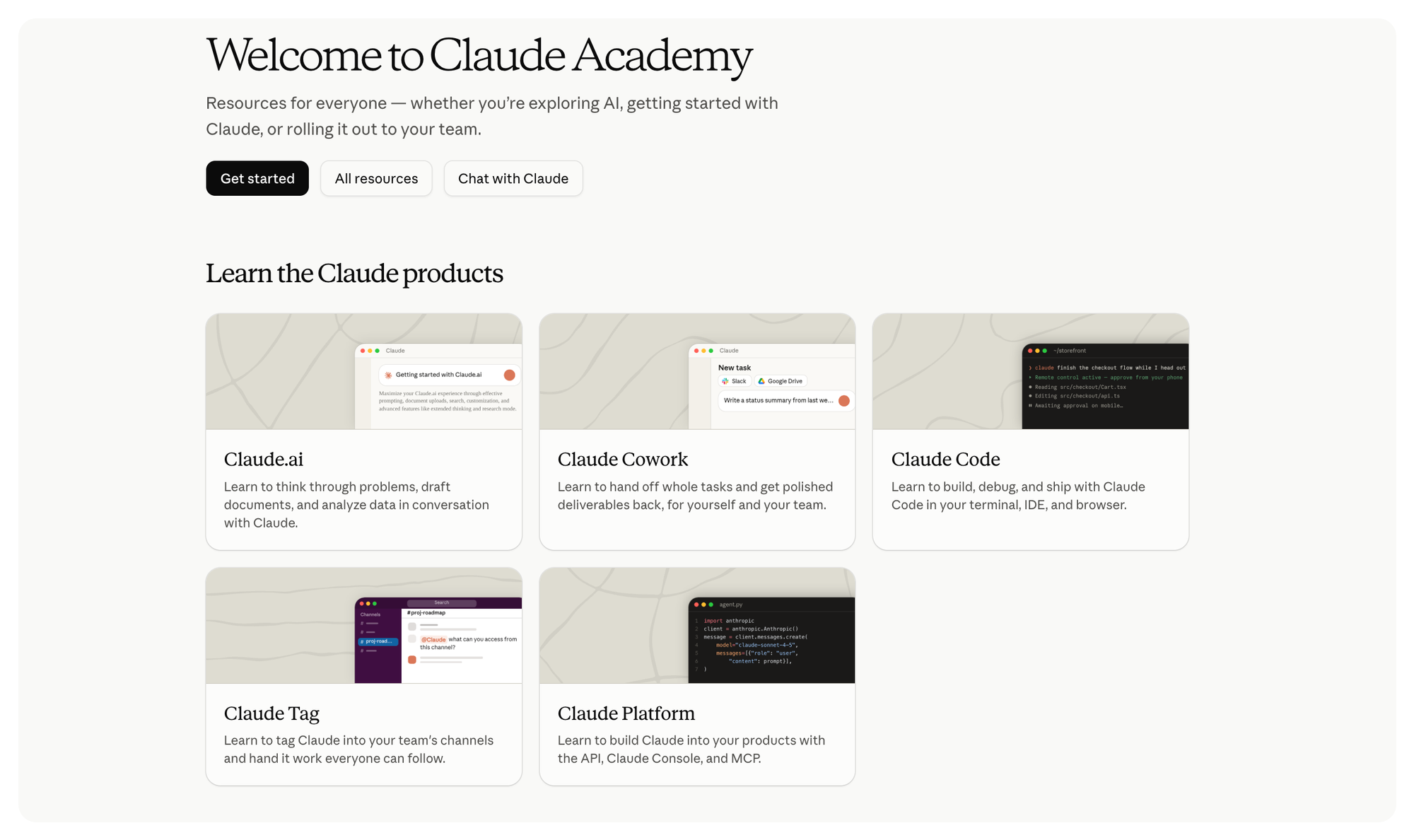
📋 The Details: You can open it now at academy.claude.com or the "Learn more" tab in your Claude profile, with recommended courses, badges, and a skill that suggests paths based on how you work.
The lessons lean on durable habits, like treating today's model as the worst you'll ever use again and learning to "verify in proportion to the stakes," and much of it stays product-agnostic rather than Claude-specific.
🎯 Why You Need to Know: The course on deciding what to hand off and what to keep maps straight onto the calls a small team makes daily... draft the sensitive part of a memo yourself, let AI build the summary slides, and tell people which was which.
⚡ Your Move: Pick one course this week and run your team through the delegation lesson, then agree where your own "keep it human" line sits before AI drifts into the wrong task.
43% of Shoppers Already Bought Something an AI Told Them To
The idea that AI recommendations and creator marketing fight over the same dollar just took a hit. A holiday study from performance agency PartnerCentric found shoppers who trust AI are five to six times likelier to trust creators, and 43% of those surveyed bought something in three months because ChatGPT, Perplexity, or a rival suggested it.
📋 The Details: The survey covered 696 AI-influenced shoppers and 319 creators. Among high-AI-trust shoppers, 61% trust creators, versus 11% for everyone else. Proof does the converting, though... 44% want reviews before acting on an AI pick, while 3% name a creator's endorsement as their top driver. PartnerCentric calls its sample directional.
🎯 Why You Need to Know: Shoppers now open on AI (27%, near Google's 30%) yet still close on Amazon and rival marketplaces, so the assistant shapes the choice well before checkout, and brands with real proof in those answers get picked.
⚡ Your Move: Quit budgeting AI visibility and creator partnerships as separate lines. Feed both the same review-grade proof, and keep product claims identical on your page, in creator content, and anywhere an assistant can quote them.
🚀 WATCH: How These AI Copy Bots Are Producing World-Class Sales Copy 50X Faster Than Even The "BEST" Copywriters On The Market…
(Plus… They Don't Get Sick, Miss Deadlines, Or Ask For Raises Either!)
Watch the full AI Copywriting Tell-All Video Here
Lowe's Shoppers Who Use Its AI Convert 3x More Often
Lowe's had a soft quarter, comparable sales basically flat as households held back on bigger home projects. Online was the bright spot, up 15.7%, and CEO Marvin Ellison pointed to one figure on the earnings call: customers who use Mylow, the retailer's AI shopping assistant, are three times as likely to buy as those who skip it.
📋 The Details: Ellison tied the online growth to more personalized web and app experiences, expanded product visualization, a growing marketplace, and Mylow itself. A second assistant, Mylow Companion, rides with store associates, feeding faster answers on the floor. Comparable sales rose just 0.2% to $26 billion, and Lowe's trimmed its full-year outlook to about $92 billion.
🎯 Why You Need to Know: A three-times conversion lift moves an on-site assistant from novelty to fixture... once the tool answering "which drill do I need" also closes the sale, building one stops being a bet on hype.
📡 Watch For: That 3x edge as Mylow spreads from early adopters to everyday shoppers. A conversion lift that survives the mainstream is the one worth copying onto your own site.
Google Now Lets Readers Pin Favorite Sources in AI Results
Google handed readers a new lever over what they see. A "Preferred Sources" button now lets people push their favorite publishers to show up more often in Search results and AI-generated summaries.
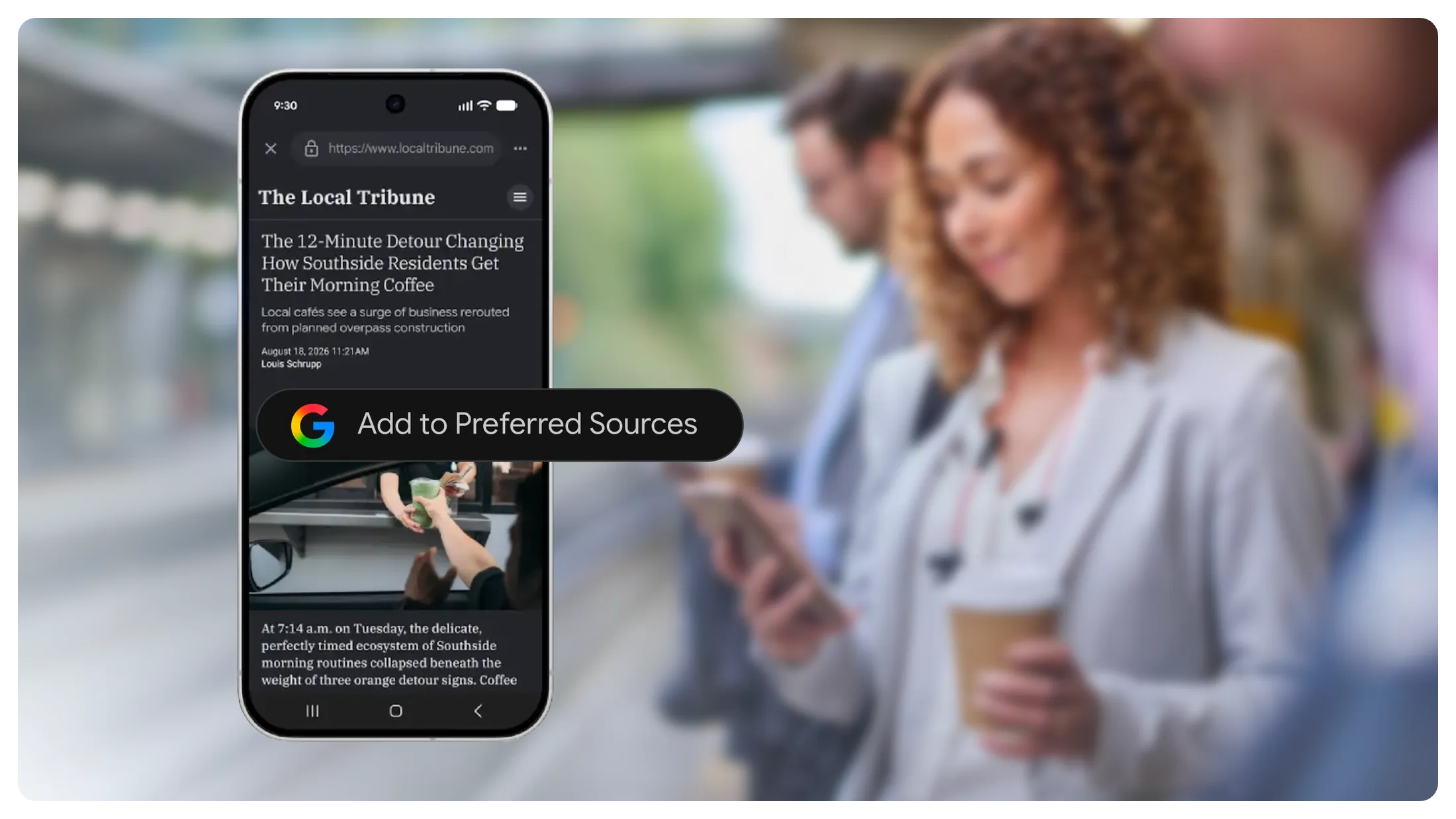
📋 The Details: The button is live now. Google is also rolling out a way to refine your Discover feed by typing in specific interests, plus custom audio news briefings in the Google News app on Android around topics you choose. Each piece points the same way: the reader tells Google which sources and subjects to favor.
🎯 Why You Need to Know: When your customers can mark your site as preferred and then see more of you inside AI summaries, earning that tap becomes a visibility play worth as much as any ranking... the AI Overview that once buried your link can surface it, at least for people who asked for you by name.
⚡ Your Move: Add a plain "make us your Preferred Source on Google" ask to your newsletter and site, the way brands once chased "hit the bell." The readers who already like you will pin you into their results.
Harvey Built a Legal AI That Undercuts Big Models on Price
Legal-AI company Harvey shipped its first model for legal work, and it lands at less than a fourth the cost of big general-purpose models. Tenet runs on a Kimi K3 base that Harvey post-trained with Fireworks AI on legal data, synthetic data, and expert work mirroring long, multi-step cases.
📋 The Details: Harvey says Tenet lifts its all-pass rate 82% on LAB over that base model, tops LAB Contracts, and places second on LAB overall. It also ships three specialist sub-models Tenet calls as helpers: M&A diligence, document review, and searching a firm's own knowledge. These are Harvey's own numbers, so read them as a vendor's.
🎯 Why You Need to Know: A model tuned for one industry, at a quarter a frontier model's cost and beating it on home turf, is a preview of other fields... when a specialist wins its niche and costs less to run, the "just use the biggest model" reflex wobbles.
📡 Watch For: A model like this landing in your industry next. Marketing, finance, and support are candidates, and the first vendor to undercut general-model pricing there resets everyone's math.
AT&T Cut Its AI Bill 56% by Routing Work to Cheaper Models
AT&T found a way to spend far less on AI without staff feeling the drop. It began routing employee queries through tools that gauge each task's difficulty and send the easy ones to cheaper models, trimming the cost of coding and other advanced work as much as 56%, per The Information. Quality slipped just 2%.
📋 The Details: The routing runs on LiteLLM, which sizes up a request and decides if a budget model can handle it. AT&T leans on open-weight options like Nvidia's Nemotron, Meta's Llama, and Google's Gemma, and wants their share of queries to climb from 40% today toward 60 to 70%.
🎯 Why You Need to Know: Those open models used to trail the frontier by six to ten months, but AT&T's Mark Austin says they're now "just as good or better" than older paid models for many jobs, so premium token rates on every request quietly bleed money.
⚡ Your Move: Before your next AI invoice, check whether a routing layer can send routine tasks to a cheaper model and save the pricey one for what truly needs it.
A Nameless AI Coding Model Is Free for One Week
A model called Ox Alpha showed up on OpenRouter and OpenCode this week with no lab name and no founder taking a bow... just a provider label and an open invitation to test it. What it carries: a million-token context window and free access OpenCode says lasts a week.
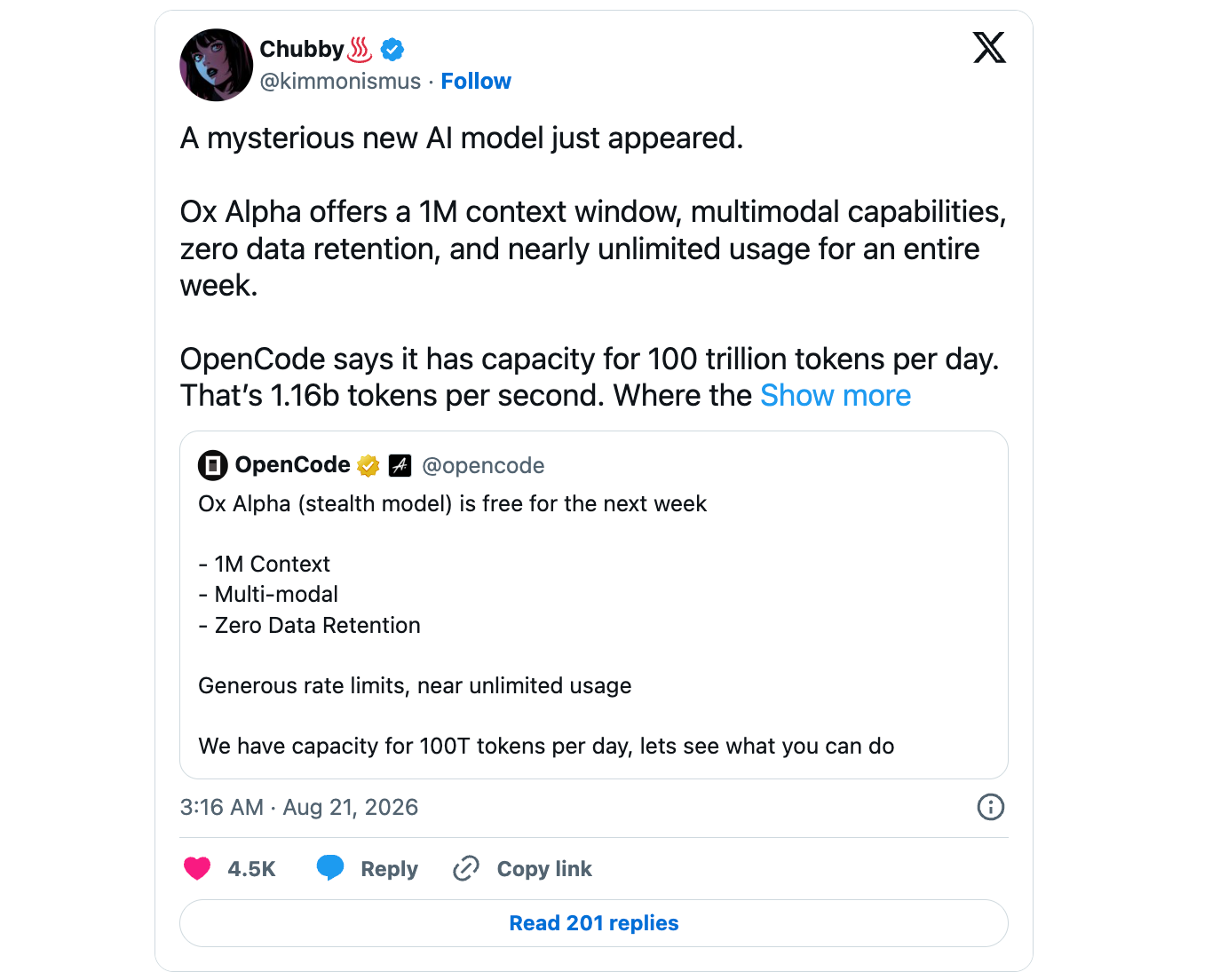
📋 The Details: OpenRouter lists it as multimodal (text, images, video), priced at zero, dated August 20. OpenCode's pitch adds zero data retention and room for heavy use. What's missing is any independent benchmark... no Artificial Analysis score, no spot yet on the public DeepSWE leaderboard, where named models like Claude Opus 5 and GPT-5.6 hold the top rows.
🎯 Why You Need to Know: A million-token window, free for a week, lets you throw a real repository at it, not a toy prompt, and see what breaks on your own code before the door closes.
⚡ Your Move: Point it at bugs you already understand, a failing test or a narrow refactor you can review line by line, and skip it for anything with customer data or credentials... an anonymous preview is no place for those.

Hyundai's Non-Coders Are Building Their Own AI Agents at Work
Something quietly shifted inside Hyundai and Kia's offices... employees with no software background started building their own AI agents for parts of their jobs. That habit rides on H Chat Pro, the group's in-house gateway to ChatGPT, Gemini, and Claude, now past 30,000 active users, roughly 80% of the two automakers' general staff.
📋 The Details: Hyundai shared the numbers at an August 12 showcase in Seoul, and the operational results are the part worth copying. An assistant that searches crash-test history cut case-review time about 90%. On the factory floor, reinforcement-learning routing cut needless downtime about 86%. A review-response tool took one customer reply from 35 minutes to roughly 5.
🎯 Why You Need to Know: Hyundai didn't route this through a specialist team... it put a secure, multi-model tool in front of ordinary employees and let them wire up their own fixes, which is how those cuts spread across dozens of workflows instead of one pilot.
📡 Watch For: Hyundai plans to fully automate its customer-review responses starting in September. Whether it runs clean with no human in the loop tests how far this delegation goes.
Nvidia Got a Perfect Score by Fixing the Harness, Not the Model
A model's results can swing wildly depending on its wrapper. Nvidia researchers took Claude Opus 5 from 30% to a perfect 100% on ARC-AGI-3, instruction-free 2D games, without touching the model. They rebuilt the harness, the wrapper of tools, memory, and rules that makes a raw model an agent.
📋 The Details: What mattered was a "supervisor" layer that nudges the agent when it stalls or heads down a dead end, plus better memory. Nvidia built the harness for the test, not as a product; it sells open pieces under Nemo. It echoes July research from Databricks, whose CEO said the wrong harness alone can 2x your costs.
🎯 Why You Need to Know: The AI tools you buy differ as much by wrapper as by the model inside, so two products on the same Claude or GPT can post very different reliability and bills... "which model does it use" settles less than you'd think.
📡 Watch For: Vendors that describe supervisor layers and memory handling, more than model names. When a vendor stops blaming a flaky day on the model, that's the wrapper at work.
Thanks for reading.
Until next time!
The AI Marketers
P.S. Help shape the future of this newsletter – take a short 2-minute survey so we can deliver even better AI marketing insights, prompts, and tools.
[Take Survey Here]
