
Monday Memo

A Byte of Knowledge
Eugene Schwartz told us 60 years ago to enter the conversation already running in the reader's head. "Meet them where they are" is old news.
But a new review out of MIT and Northeastern, written by two brain scientists pushes that idea somewhere stranger.
They argue the brain doesn't see a thing and then pick a reaction.
It picks the reaction first, then builds a category to explain what just happened.
Read that again.
The body leans toward "buy" or "bail" before the mind even names what's on the screen.
Which means our prospect's thumb is already drifting toward the back button (or the order button) before the headline finishes loading.
Their belief about us isn't driving the click.
It's the receipt the brain prints after the body already moved.
So don't write to change minds.
Write to interrupt the motion... in the half-second before the receipt prints.
(Source Paper Here)
🚀 WATCH: How These AI Copy Bots Are Producing World-Class Sales Copy 50X Faster Than Even The "BEST" Copywriters On The Market…
(Plus… They Don't Get Sick, Miss Deadlines, Or Ask For Raises Either!)
Watch the full AI Copywriting Tell-All Video Here
Something to Ponder
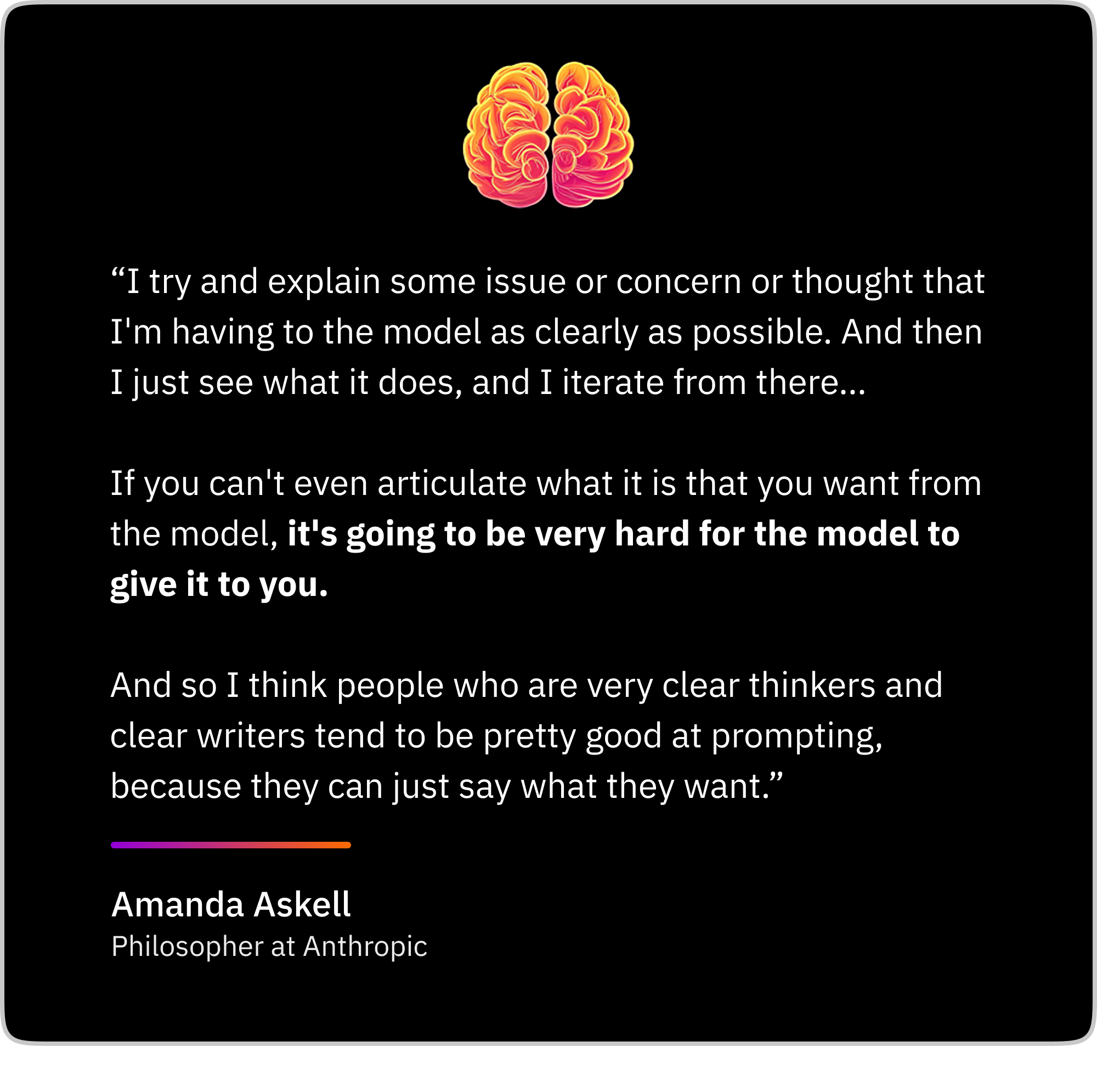
We Asked – AI Answered
Our Question:
"Which company brings in the most money while employing the fewest people? And how did they achieve such leverage?””
AI's Answer: The $33 Million Employee: Inside The Greatest Leverage Machine on Earth 💸
Forget Apple. Forget Nvidia. Forget Goldman Sachs.
The most efficient money-printing operation on the planet runs with roughly 150 to 300 people on payroll. Total. Worldwide.
Its name is Tether. 🪙
📊 The Numbers That Should Wake You Up
Bloomberg's March 2025 analysis pegged Tether's profit per employee at over $33 million. Electric Capital co-founder Avichal Garg calculated it closer to $85.6 million per head using earlier headcount figures.
Stacked against the titans:
→ Goldman Sachs: ~$288K per employee → Apple: ~$571K per employee → Meta: ~$455K per employee → Nvidia: ~$1M per employee → Tether: $33M to $85M per employee 🤯
For 2025, Tether posted $10 billion in net profit, down 23% from the prior year's $13 billion. A workforce smaller than your average regional hospital generated more cash than Bank of America.
🏦 The Business Model in 30 Seconds
Tether issues USDT, a "stablecoin" pegged 1:1 to the US dollar. The loop:
1️⃣ A trader, exchange, or Argentinian saver hands Tether $1
2️⃣ Tether mints them 1 USDT (a digital dollar)
3️⃣ Tether takes that $1 and buys US Treasuries
4️⃣ Treasuries pay 4-5%...and Tether keeps every basis point
5️⃣ The depositor receives zero yield. Just the token.
Multiply by over $186 billion in circulating USDT and you've engineered a money market fund where customers volunteer to earn nothing. That's not a bug. That's the entire business.
Tether's US Treasury exposure now ranks it the 17th-largest holder of US debt globally...more than most countries on Earth.

⚡ The Leverage Stack
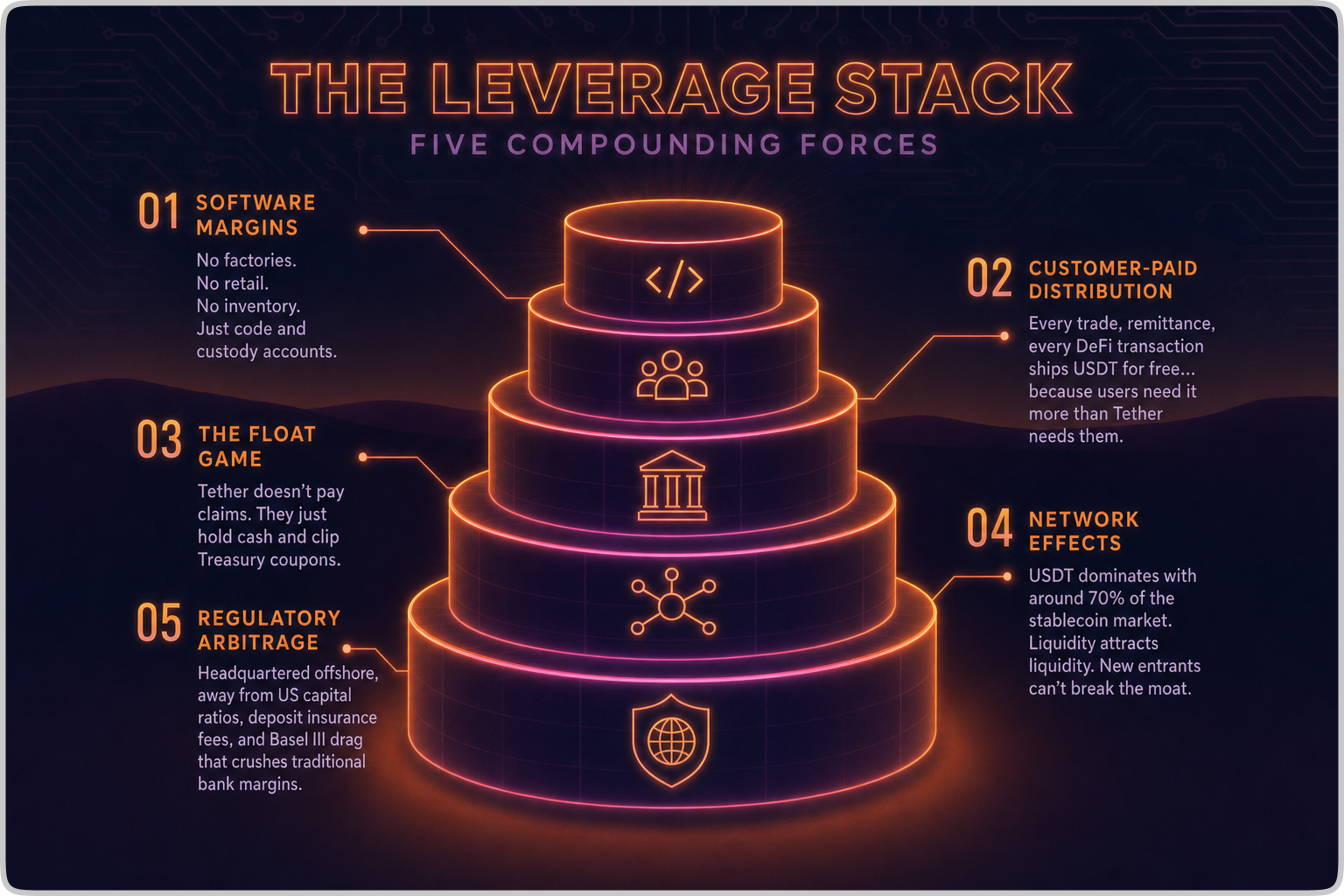
This isn't luck. It's architecture. Five compounding forces:
🔹 Software margins. No factories. No retail. No inventory. Just code and custody accounts.
🔹 Customer-paid distribution. Every Binance trade, every Latin American remittance, every DeFi transaction ships USDT for free…because users need it more than Tether needs them.
🔹 The float game. Same trick Warren Buffett ran with insurance at Berkshire Hathaway...except Tether doesn't pay claims. They just hold cash and clip Treasury coupons.
🔹 Network effects. USDT dominates with around 70% of the stablecoin market. Liquidity attracts liquidity. New entrants can't break the moat.
🔹 Regulatory arbitrage. Headquartered offshore, away from US capital ratios, deposit insurance fees, and Basel III drag that crushes traditional bank margins.
🎯 The Takeaway for Operators
Tether didn't win by hiring harder. They engineered a business where the customer becomes the distribution, the asset does the labor, and the headcount stays microscopic.
Three questions for your own shop:
❓ Who is doing work you currently pay employees for...that customers would happily do themselves?
❓ Where is your float? The cash you hold between collection and delivery is an asset most operators completely ignore.
❓ Which seats are you renting from humans that should be running on code or a workflow?
The lesson is uncomfortable but undeniable: in 2026, a small team plus the right asset plus a network effect beats a thousand-person org chart every time.

Thanks for reading the Monday Memo.
Until next time!
The AI Marketers
P.S. Help shape the future of this newsletter – take a short 2-minute survey so we can deliver even better AI marketing insights, prompts, and tools.
[Take Survey Here]
