
Monday Memo
A Byte of Knowledge
Building an AI workflow can be a grind.
There's trial and error, rabbit holes that lead nowhere, afternoons where the agent skips a step and you wonder why you didn't just do it by hand.
What keeps us going is this: you only have to get it right once.
Because a workflow that finally holds is a mold, and a mold doesn't care what you pour into it.
The research step you fought to tune, the angle selection, the review gate, all of it works the same for the next client, the next niche, the next offer.
So instead of rebuilding, you point your agent at the one that works and say, run this for the new thing.
It handles the swap, and you skip straight past the grind you already paid for.
One hard build, then a system you can leverage for years.
🚀 WATCH: How These AI Copy Bots Are Producing World-Class Sales Copy 50X Faster Than Even The "BEST" Copywriters On The Market…
(Plus… They Don't Get Sick, Miss Deadlines, Or Ask For Raises Either!)
Watch the full AI Copywriting Tell-All Video Here
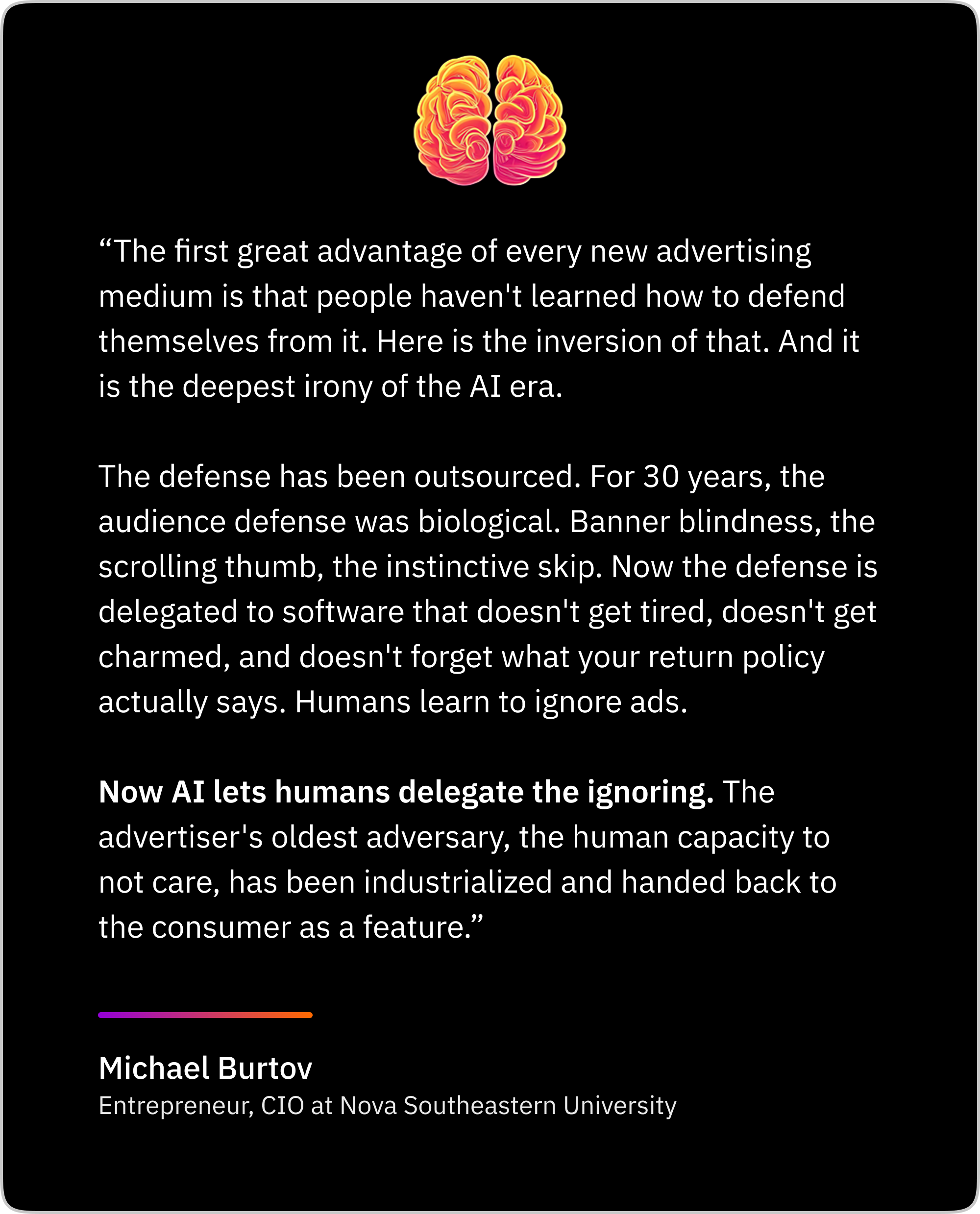
Something to Ponder
We Asked – AI Answered
Our Question:
“What are the five most harmful psychological biases that marketers need to avoid in the current state of online marketing and advertising?”
AI's Answer: Five Biases That Blind Marketers to Their Own Market 🧠
Every marketer swears they follow the data... yet the costliest mistakes start inside their own heads.
1. 🪞 The Mirror Trap (False Consensus Effect)
In 1977, Stanford psychologist Lee Ross asked students to wear a sandwich board around campus reading "Eat at Joe's." Those who agreed guessed most peers would agree. Those who refused assumed most would refuse. Each side thought it was normal.
Now move that into an agency. A 2019 Reach Solutions study, The Empathy Delusion, compared 199 UK marketers with 2,000 ordinary adults:
→ Handed £50 to split with a stranger, 77% of the mainstream split it evenly... only 69% of marketers did
→ Marketers placed far less weight on the "binding" values psychologist Jonathan Haidt mapped, like loyalty and respect for authority
You write for your Slack channel while your buyer lives somewhere else.
2. 🥁 The Curse of Knowledge
In 1990, Stanford grad student Elizabeth Newton had people tap songs like "Happy Birthday" on a table while a partner guessed the tune.
- Tappers predicted a 50% success rate
- Listeners named 3 songs out of 120, a 2.5% hit rate
The tapper hears the melody in his head. The listener hears a guy knocking on furniture.
Your copy plays a melody only you can hear:
❌ "AI-powered omnichannel attribution"
✅ "See which ad made you money"
3. 📏 The McNamara Fallacy
Defense Secretary Robert McNamara managed Vietnam by body count because body counts were easy to tally. Sociologist Daniel Yankelovich later laid out the slide:
1️⃣ Measure what's easy to measure
2️⃣ Disregard what isn't
3️⃣ Presume the unmeasurable doesn't matter
4️⃣ Declare it doesn't exist
Last-click attribution runs the same play. When economists at eBay and UC Berkeley switched off eBay's brand-keyword ads, 99.5% of the lost clicks came back through free organic results. Their estimated return on non-brand search ads: −63%. The ads kept taking credit for loyal shoppers who would have bought anyway.
4. ✈️ Survivorship Bias
In WWII, military analysts studied returning bombers and wanted armor where the bullet holes clustered. Statistician Abraham Wald told them to armor the spots without holes. Bombers hit there never made it home.
📂 Your swipe file works like that hangar:
- Gurus publish the webinar that did seven figures and bury the ones that flopped
- You copy the winning hook without seeing how many brands ran it and lost
5. 🎲 Overconfidence (Feeding the HiPPO)
Ronny Kohavi led experimentation at Microsoft. His scorecard (Harvard Business Review, 2017):
📊 Microsoft: about one in three tested ideas improves its target metric; the rest land flat or do damage
📊 Google and Bing: 10–20% of experiments produce positive results
One Bing employee's idea for displaying ad headlines sat for months as a low priority. Once an engineer tested it, revenue jumped 12%, worth more than $100 million a year in the U.S. alone.
Kohavi popularized a name for the executive who overrules the test: the HiPPO, or Highest Paid Person's Opinion. Friedrich Hayek had a name for planners who think a handful of experts can outguess millions of people choosing for themselves... "the fatal conceit."
🎯 The Fix
Each of these biases flatters the marketer. Test before you trust your gut, and spend time with buyers who look nothing like your team. Then let customers settle the argument with their wallets.

Thanks for reading the Monday Memo.
Until next time!
The AI Marketers
P.S. Help shape the future of this newsletter – take a short 2-minute survey so we can deliver even better AI marketing insights, prompts, and tools.
[Take Survey Here]
