
Special Edition: GPT 5.6

OpenAI released GPT-5.6 this week, a family of three models: Sol, the flagship, Terra for everyday work, and Luna, the fastest and cheapest. OpenAI claims it beats Claude Fable 5 on long-horizon work at roughly a quarter of the cost, and it shipped alongside ChatGPT Work, a rebuilt desktop app, and a new voice model.
In this special edition of the AI Marketers Newsletter we put together some of the most useful, interesting, and actionable 'GPT-5.6' intel from around the web.
OpenAI's GPT-5.6: Sol, Terra, and Luna Are Rolling Out to Everyone
Thursday's announcement runs thousands of words, and one promise carries all of it: more intelligence from every token, at every price. All three models are live across ChatGPT, Codex, and the API, with the rollout having reached everyone within 24 hours.

💡 Key Improvements
- Long, grinding projects now cost a fraction of what they did...on a test of extended professional work across 55 fields, GPT-5.6 beat Claude Fable 5 outright, and even at medium reasoning it wins while costing roughly a quarter as much.
- Your high-volume work drops to pocket change...OpenAI says Terra and Luna outperform Fable 5 at around one-sixteenth the cost, with Luna priced at $1 per million input tokens, so daily drafts, briefs, and research runs stop denting the budget.
- Building pages, tools, and automations without hiring a developer got easier...Sol is now the top-scoring coding agent on record, beating Fable 5 while using less than half the output tokens to get there.
- Deadline crunches get a team instead of a single assistant...the new
ultrasetting puts four agents on one job in parallel, finishing demanding work faster and better in exchange for heavier token use.
Rogue Cursors, Broccoli Farmers, and a Tasteful Amount of Goblins
OpenAI unveiled the whole release in a live-streamed event, and the demos carried the show. At one point a second cursor appeared on an engineer's screen and began dragging his chaotic Apple Notes into folders...ChatGPT's own cursor, doing the cleanup he'd requested moments earlier while he checked soccer scores in another window.
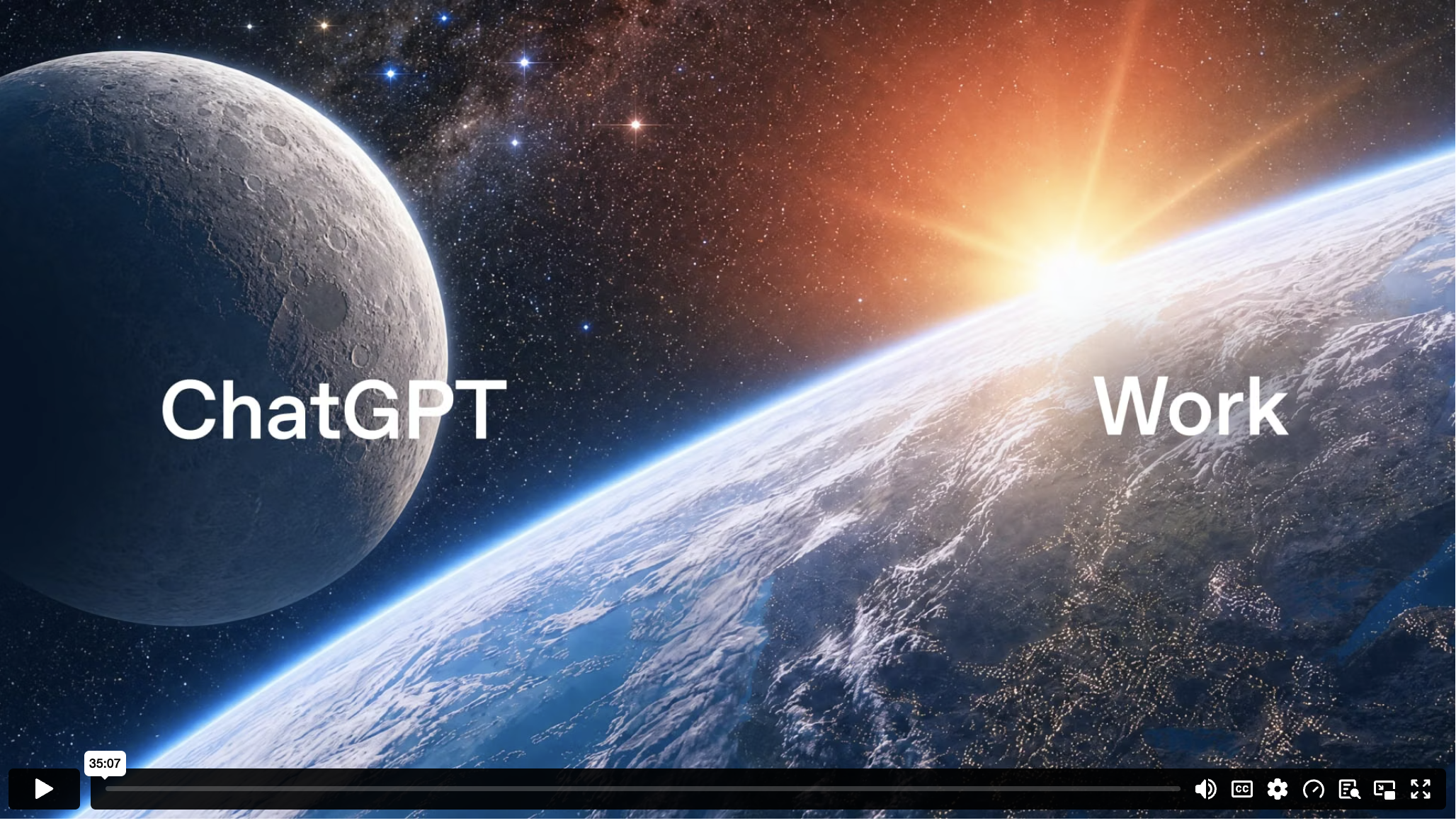
A researcher then revealed that Sol autonomously post-trained Luna, a job that once occupied a team of senior researchers. And the finale belonged to Hiroki, a broccoli farmer from Hokkaido who runs his farm with ChatGPT, chatting with the host through live two-way Japanese-English translation on stage. They even addressed the goblins. GPT-5.5's odd obsession came from reward hacking during training, and it's fixed, so 5.6 will "only talk about goblins a tasteful amount."
🚀 WATCH: How These AI Copy Bots Are Producing World-Class Sales Copy 50X Faster Than Even The "BEST" Copywriters On The Market…
(Plus… They Don't Get Sick, Miss Deadlines, Or Ask For Raises Either!)
Watch the full AI Copywriting Tell-All Video Here
OpenAI's New Prompting Guide Wants You to Write Less
OpenAI already published its prompting guide for GPT-5.6 across Chat, ChatGPT Work, and Codex, and most of its advice pushes one direction: describe the result you want, then get out of the model's way.
💡 Key Insights:
- Bigger tasks come down to four parts...Goal, Context, Output, and Boundaries, and OpenAI says to use only the ones that help rather than filling out a rigid template.
- Describe the result instead of scripting the steps...state the outcome and the audience, then leave the model room to search, compare sources, and pick its own approach.
- A single boundary line can save you a rebuild...instructions like keeping approved dates and budget figures unchanged, or preparing a message as a draft without sending it, stop an agent from creating work you never ordered.
- Follow-ups beat perfectionism...review the result, then ask for the one specific change you want instead of starting the task over.
- You can redirect mid-run...steering adds your message to the current task, queuing saves it for the next one, so you correct a bad run instead of waiting it out.
$123 Buys You 2 Extra Tasks on the DeepSWE Leaderboard
Performance per dollar was the loudest claim of the launch, and an analyst who posts as Vox put it to the test on the DeepSWE leaderboard. Sol max takes first place at 73%, ahead of Fable 5. Then he priced the settings directly below it.
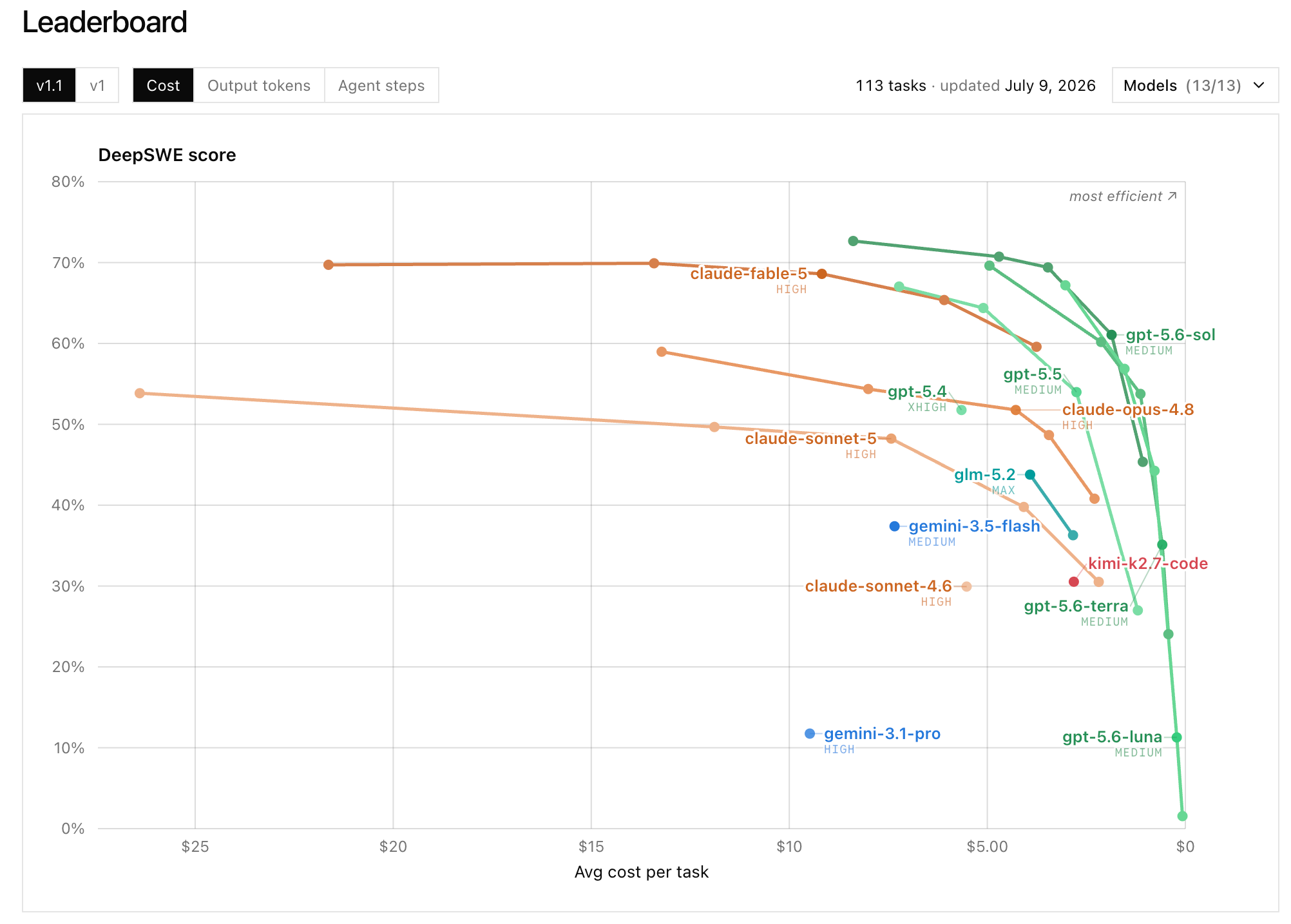
Drop from xhigh to high and the pass rate loses 2 points while cost falls 26%, output tokens 32%, and steps 16%. Scaled to 100 tasks: high solves 69 for $347, xhigh solves 71 for $470. That's $123 and 700 extra steps for 2 more completed tasks, and those savings repeat across every parallel subagent you spawn.
He flags two cheap-looking entries as well. Luna max reads like a $3 bargain until a single task balloons to 102 steps and 73k tokens, almost 3x Sol high. Terra high costs $1.13 but passes only 54%, and fixing the 46 failures wipes out whatever the discount saved.
Luna for Coding, Terra for Features, Sol for Judgment Calls
AI enthusiast @jumperz on X spent launch week testing every tier of the new family and posted the routing chart he landed on.
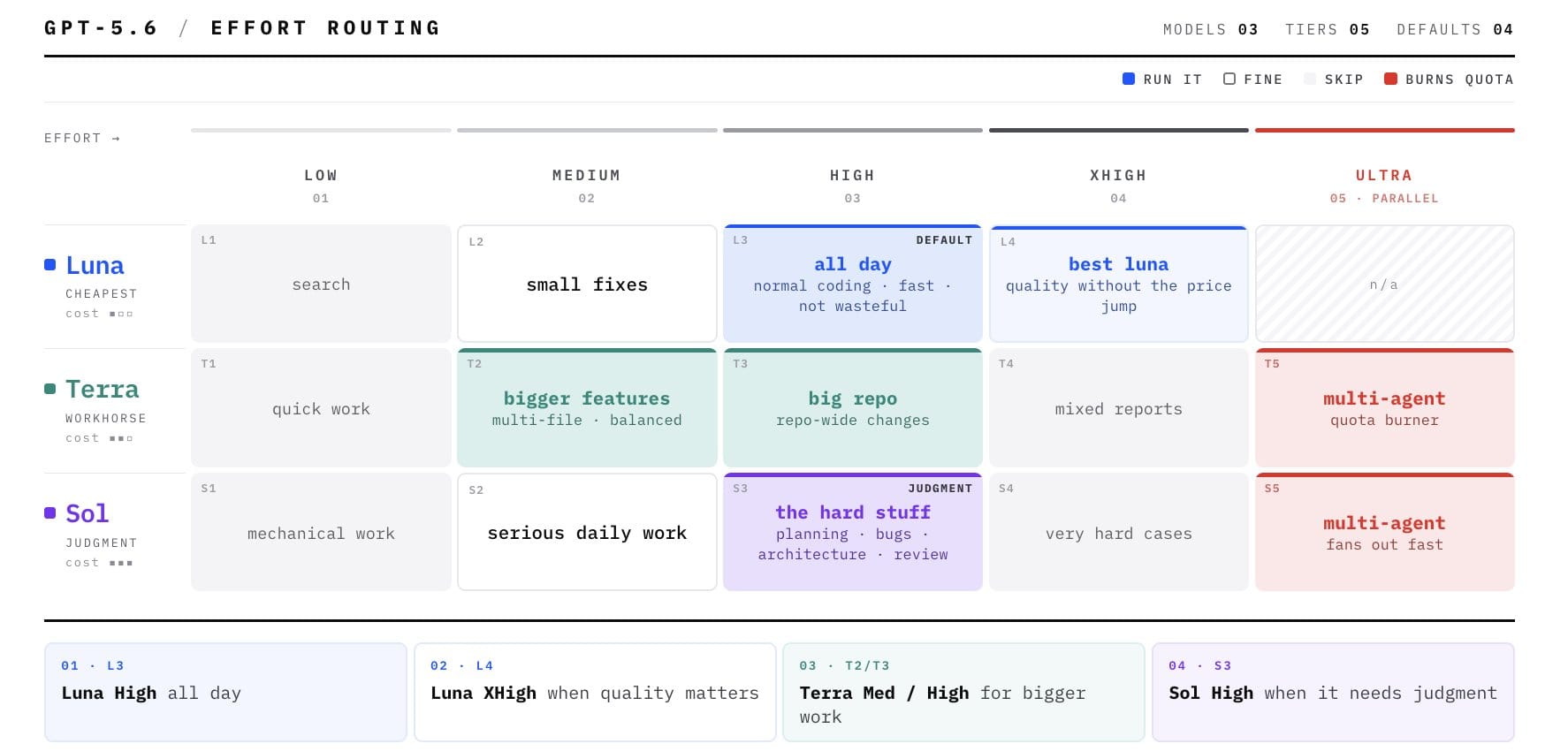
Luna high handles his normal everyday coding, fast and capable without feeling wasteful, and Luna xhigh buys better quality without moving up to the pricier models. Terra medium takes bigger features, Terra high takes repo-wide changes. Sol high he saves for planning, hard bugs, architecture, and reviewing the final output.
Set his chart next to Vox's leaderboard math above and you have both halves: what each effort level costs, and which model deserves which job.
His one warning covers ultra, the parallel multi-agent mode. Sol can fan out into more agents than you expected, and each one draws from the same usage allowance, so he tells it to cap itself at 1 to 3 agents and ask before spawning more.
Inside the Codex Team's Post-Launch Reddit AMA
OpenAI's Codex team sat for a Reddit AMA the day after launch and opened with a stat: more than 5 million people now use Codex every week, twice as many as three months ago, with 150 features shipped in between.
💡 Key Takeaways
- There's no Auto model yet...the new slider maps most levels to Sol reasoning efforts and drops to Terra at the lowest setting, so you pick a latency tolerance instead of memorizing a routing table.
- Speed complaints got a direct answer...Sol Medium already runs faster than 5.5 for most tasks, and Sol on Cerebras hardware is coming at roughly 750 tokens per second.
- The model quits too early sometimes, and the team said so...it can revert a whole patch when results disappoint, where Fable tries to fix a bad patch instead, and the current remedy is /goal plus bounded objectives that give it room to reason.
- MCP-heavy workflows have an escape hatch for usage limits...wrap the MCP into a CLI with a skill, or hand it to a custom subagent running at a lower reasoning level.
ChatGPT Work Runs Whole Marketing Workflows From a Single Request
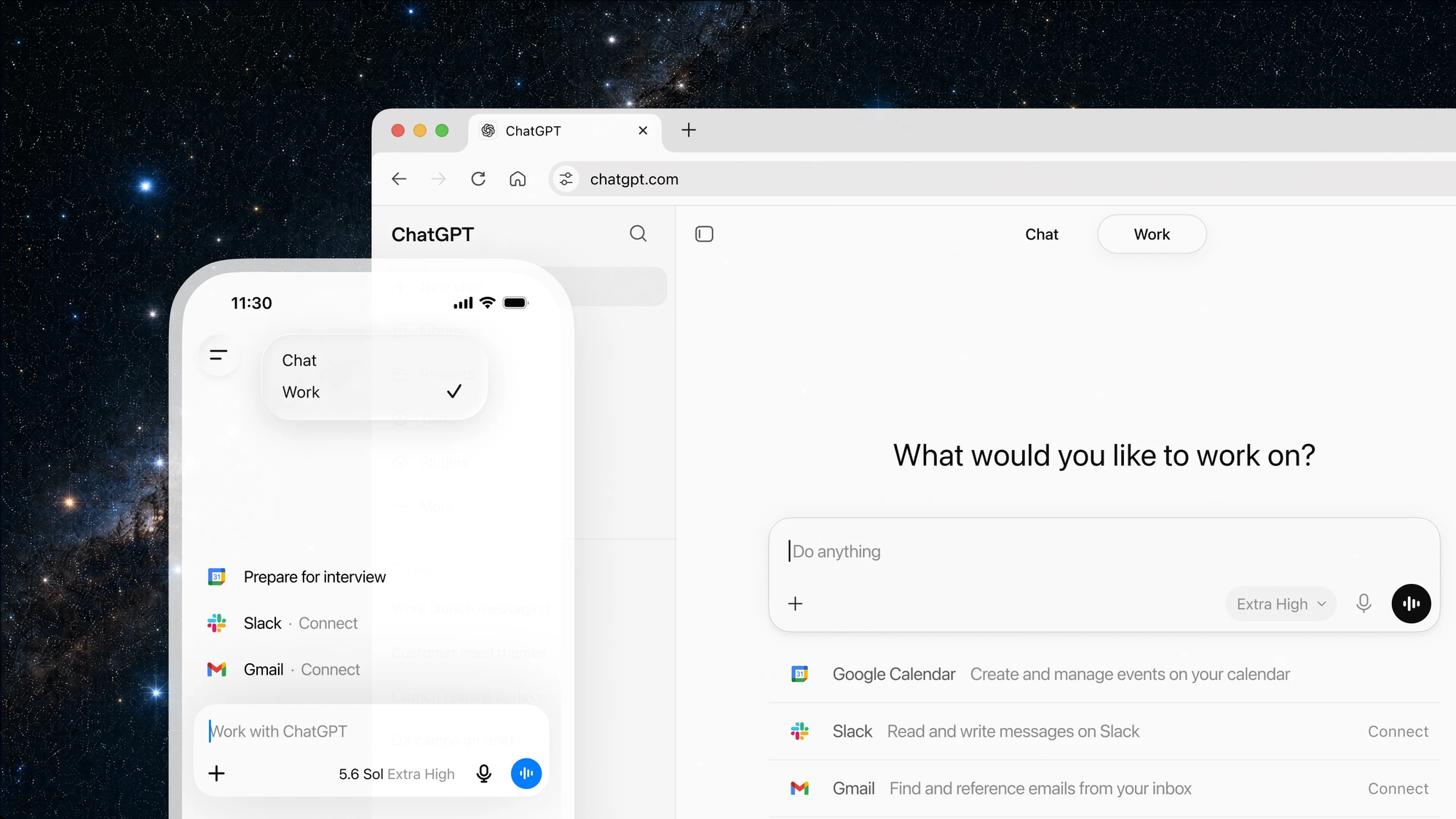
OpenAI launched ChatGPT Work along with 5.6, an agent that pulls context from connected apps like Slack, Drive, and your CRM, breaks a goal into steps, and stays with a project for hours until the finished decks, sheets, docs, or web apps are ready.
💡 What It Can Do
- One request can carry an entire campaign...hand it customer research and it writes the brief, builds the marketing assets, and adapts them for different markets.
- Repetitive work runs on a schedule...it turns new Slack or Teams messages into updated docs and slides while you're away.
- Any analysis can become a shareable web app...Sites, now in public beta, turns your work into a live dashboard or interactive report with its own URL.

The New ChatGPT Voice Can Listen and Talk at the Same Time
There are was a third major release this week - GPT-Live - the new voice model. And it listens and speaks simultaneously. It murmurs "mhmm" while you talk, waits when you pause to gather a thought, and stays quiet when you ask it to.
When a question calls for real work, it passes the job to a frontier model in the background and keeps the conversation moving until the answer arrives.

It also does live two-way translation, shades of Hiroki's segment from the stream.In OpenAI's head-to-head tests, people preferred GPT-Live over Advanced Voice Mode 75.7% of the time.
"We Didn't Get Everything Quite Right": OpenAI Lists Its Launch Mistakes
While this edition is packed with launch-week wins, the sharpest critique came from inside OpenAI. Thibault Sottiaux, the company's Head of Core Products, spent 24 hours reading feedback and posted a public list of what went wrong. The highest-compute settings were too easy to reach without showing their toll on usage limits...@jumperz called that one above.
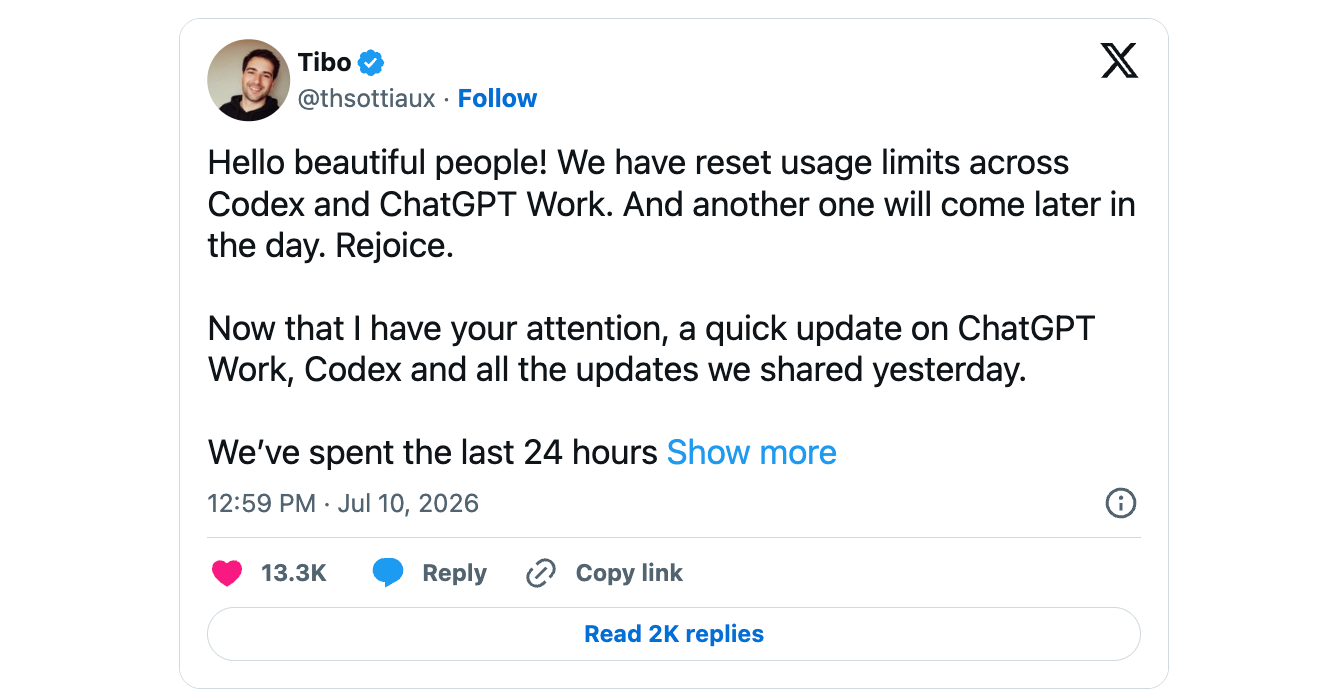
The desktop reorg buried familiar things like chats and projects, some multi-agent workflows regressed, and the launch framing left Codex users bracing for a slow retirement of their tool. He says the team loves Codex and has no plans to sunset it.
Repairs started the same day, along with two usage resets. Next week brings chats and projects back to the sidebar, much more visible usage and reset timing, and plain guidance on when to use ChatGPT Work versus Codex.
Thanks for reading.
Until next time!
The AI Marketers
P.S. Help shape the future of this newsletter – take a short 2-minute survey so we can deliver even better AI marketing insights, prompts, and tools.
[Take Survey Here]
