
Monday Memo
A Byte of Knowledge
Film professors at UW–Madison are sounding an alarm that every marketer needs to hear...
They can't get their students to finish movies anymore.
Students half-watch while scrolling. Or they skip the film entirely and figure they'll piece it together from 'vibes.'
Then the final exam lands on their desk.
One recent question asked what happens at the end of the French classic Jules and Jim.
More than half the class said the characters hide from Nazis.
Others said Ernest Hemingway shows up and gets drunk with them.
The film takes place during World War I...and Hemingway isn't even in it.
These kids didn't simply misremember. They hallucinated plots that never existed.
The professor has taught this course for almost twenty years, but he's NEVER had to curve grades like this.
Your prospects are swimming in that same attention crisis.
Sure,we've always known copy needs to hook people fast.
But we've crossed into different territory now.
A whole generation can't sit through a two-hour movie even when their GPA depends on it.
Your emails, your landing pages, your VSLs... they're fighting against brains that have been rewired to abandon everything.
🚀 Whether you're selling a $50 supplements or a $10,000 coaching program – having these 5 'Copy Blocks' on your landing page could be the difference between crickets and an avalanche of cash flow.
Discover All 5 'Copy Blocks' Now
Something to Ponder
We Asked – AI Answered
Our Question:
"Where's the breaking point between 'too much hassle to cancel' and 'too expensive to ignore' for subscriptions with difficult cancellation processes? Does this vary by type of service?"
AI's Answer: Does Handwriting Copy Actually Work? The Neuroscience Says Hell Yes
Look, I get it. Sitting down and hand-copying Gary Halbert letters like some medieval monk sounds about as scientific as reading tea leaves. But here's the old-school copywriters were accidentally right.
🔬 The Brain Science
Forget the guru speak....let's talk raw brain scans.
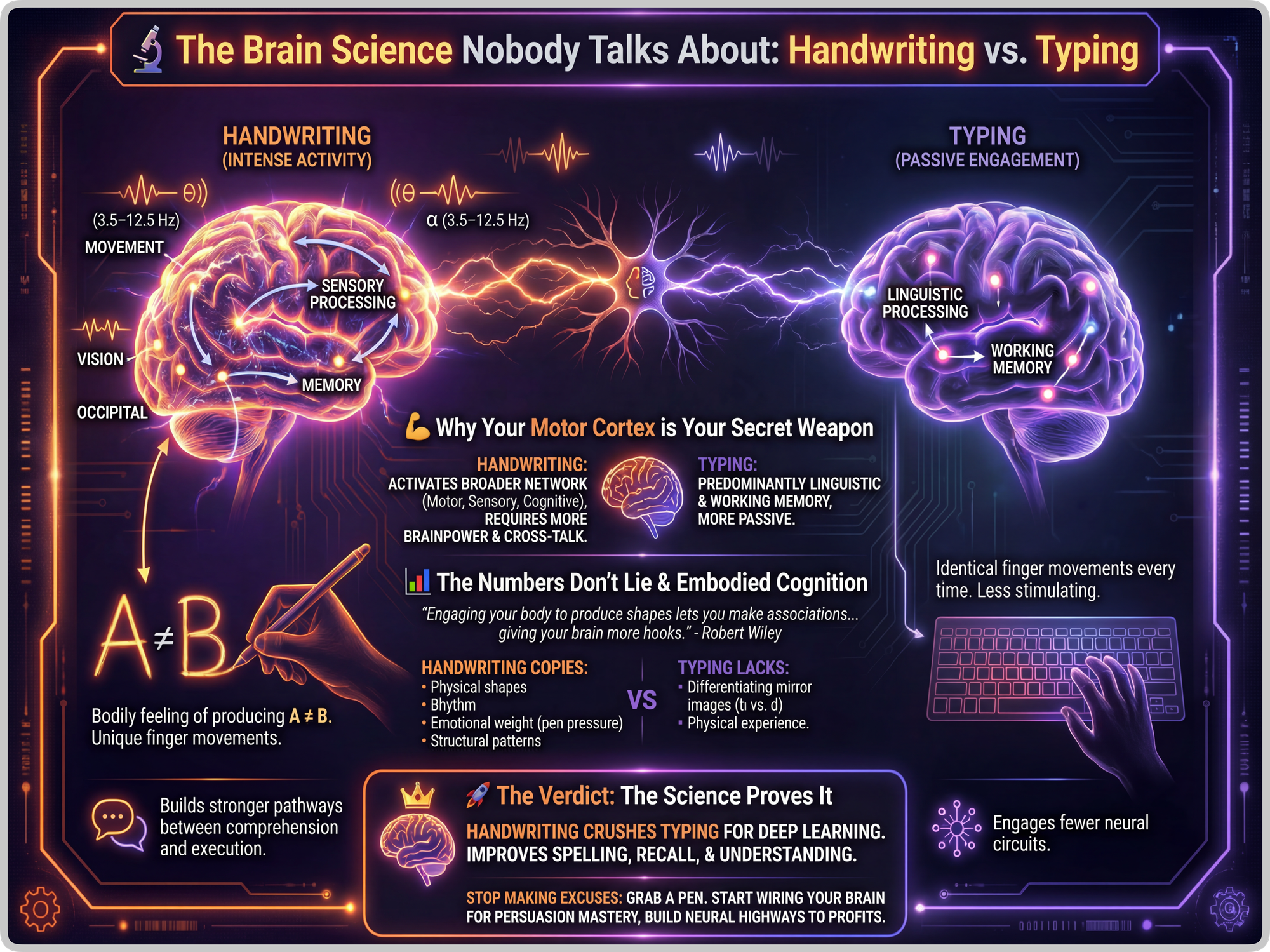
When you're writing by hand, you immediately feel that the bodily feeling of producing A is entirely different from producing a B, while typing the same letter requires identical finger movements every time.
Norwegian researchers stuck 256 electrodes on students' heads and discovered something wild: those writing by hand had higher levels of electrical activity across a wide range of interconnected brain regions responsible for movement, vision, sensory processing and memory.
💪 Your Motor Cortex = Secret Weapon
Think typing and writing fire up the same circuits? Dead wrong:
THE FACTS:
• Handwriting requires a lot more fine-tuned coordination between the motor and visual systems. This seems to more deeply engage the brain in ways that support learning.
• Handwriting activates a broader network of brain regions involved in motor, sensory, and cognitive processing. Typing engages fewer neural circuits, resulting in more passive cognitive engagement.
• With handwriting, the researchers saw increased activity, specifically in low frequency bands called alpha and theta, not only in the expected motor areas due to the movement but also in others associated with learning.
Translation: When you trace Eugene Schwartz headlines with a pen, your brain builds stronger pathways between comprehension and execution than any keyboard warrior ever will.

📊 The Embodied Cognition Payoff
💡 "There seems to be something fundamental about engaging your body to produce these shapes," says Robert Wiley, a cognitive psychologist at the University of North Carolina, Greensboro. "It lets you make associations between your body and what you're seeing and hearing," which gives the mind more footholds for accessing concepts.
When you copy power words by hand, your motor memory encodes:
✓ Physical letter shapes and formations
✓ Rhythm and pacing of sentences
✓ Emotional weight through pen pressure
✓ Structural patterns at a gut level
⚠️ The Kid Test That Should Scare You
"This also explains why children who have learned to write and read on a tablet, can have difficulty differentiating between letters that are mirror images of each other, such as 'b' and 'd'. They literally haven't felt with their bodies what it feels like to produce those letters," says researcher Audrey van der Meer.
If skipping handwriting stunts kids' brains, imagine what you're missing by not hand-copying proven winners.
🚀 THE VERDICT
This isn't nostalgia talking. Plenty of previous research has shown that handwriting improves spelling accuracy, memory recall and conceptual understanding.
Those old direct response legends stumbled onto brain gold without knowing the science. Connectivity of different brain regions increased when participants wrote by hand, but not when they typed.
Stop making excuses. Find sales letters that made millions, grab a pen, and start wiring your brain for persuasion mastery. The science proves it: handwriting crushes typing for deep learning. Period.
Thanks for reading the Monday Memo.
Until next time!
The AI Marketers
P.S. Help shape the future of this newsletter – take a short 2-minute survey so we can deliver even better AI marketing insights, prompts, and tools.
[Take Survey Here]
