
Monday Memo
A Byte of Knowledge
There's an old idea from sociology called "Broken Windows Theory."
Leave one shattered pane in a building and nobody fixes it?
Soon the whole block looks like a war zone. The unfixed damage signals that nobody's watching.
That nobody cares.
We see the same thing play out in client relationships.
A prospect shows up 20 minutes late to the discovery call.
They mention they've fired their last three agencies.
They keep adding "just one more thing" to the scope before you've even signed.
These are broken windows.
And most of us walk right past them because we want the deal.
We tell ourselves the behavior will magically improve once the contract's signed.
It won't.
The relationship gets defined by what you tolerate in that first conversation.
If you let them disrespect your time on day one, they'll burn down the whole house by month two.
So here's the move: when you spot a red flag, stop the sales process cold. Name it.
Ask them to address it before you discuss price or deliverables.
"We've rescheduled three times. If we work together, I need calls to be a priority...can you commit to that?"
Feels risky. But only someone with real options would say it.
And that's exactly the signal you want to send.
🚀 Whether you're selling a $50 supplements or a $10,000 coaching program – having these 5 'Copy Blocks' on your landing page could be the difference between crickets and an avalanche of cash flow.
Discover All 5 'Copy Blocks' Now
Something to Ponder
We Asked – AI Answered
Our Question:
"Where's the breaking point between 'too much hassle to cancel' and 'too expensive to ignore' for subscriptions with difficult cancellation processes? Does this vary by type of service?"
AI's Answer: The Price Psychology of Subscription Cancellation
🎯 The Magic Numbers
Our research found that 71% of survey respondents cited price increases as the number one reason for loss of customers. Undoubtedly, price impacts churn.
Subscribers both signup and cancel more readily in categories with lower price points.Here's the harsh reality about cancellation thresholds:
The Inertia Zones:
💤 $5-15/month: "The Forgotten Zone"
- The churn rate for subscriptions under $10 tends to be highest
- People literally forget these exist (Spotify, Netflix basics)
- Cancellation friction feels disproportionate to savings
- Businesses BANK on this mental accounting error
😴 $20-40/month: "The Procrastination Paradise"
- Gyms live here – intentionally
- One-time purchases require more deliberate spending decisions, whereas recurrent payments tend to drift into the background. This decreases the psychological "pain" of leaving with money.
- Effort-to-savings ratio creates decision paralysis
- Companies make cancellation JUST annoying enough
⚡ $50-75/month: "The Action Threshold"
- People start actively reviewing these charges
- E-commerce subscribers are more likely to be 25 to 44 years old, to earn between $50,000 to $100,000 – this demographic scrutinizes mid-tier subscriptions
- Cancellation becomes a calendar event, not "someday"
🔥 $100+/month: "The Vigilance Zone"
- Those in the $100,000+ income bracket had the highest number of subscriptions to pet services, with an average of 2.23, though this fell to 1.56 – even wealthy consumers cut these
- Immediate action on dissatisfaction
- Companies MUST deliver value or face instant churn

📊 Category-Specific Breaking Points
Entertainment/Streaming:
- Breaking point: $15-20/service
- Nearly 40% of subscribers of any service type cancel. More than a third cancel in less than three months, and over half cancel within six
- Stack effect: Total streaming >$60 triggers audit
Fitness/Wellness:
- Sweet spot scam: $25-45
- Numerous individuals enroll in gym memberships with the best of intentions; however, as their motivation wanes, they find it difficult to cancel due to feelings of guilt over the money already spent
- Sunk cost fallacy + shame = profit margin
Software/SaaS:
- B2B threshold: $100-200/month
- B2C threshold: $30-50/month
- Direct-to-consumer (DTC) subscription businesses experience higher customer churn rates than business-to-business (B2B) businesses. Digital Media and Entertainment, Consumer Goods and Retail, and Education industries have an average churn rate of 6.5%. In contrast, their B2B counterparts–Software and Business & Professional Services–have an average churn rate of 3.8%
The Dark Psychology Playbook 🧠
1. "Roach Motel" Design
- The unreasonable desire to avoid "wasting" previous investments prevents them from canceling
- Sign up in 2 clicks, cancel requires phone call
- Intentional friction = pure profit
2. Annual Bait-and-Switch
- My Adobe subscription was an annual plan, paid monthly... if I unsubscribed I would incur a fee... equal to 50 per cent of the amount left on the yearlong contract
- Hidden penalties create artificial switching costs
3. The "Pause" Trap
- Offer to pause instead of cancel
- 67% never reactivate but keep paying "just in case"
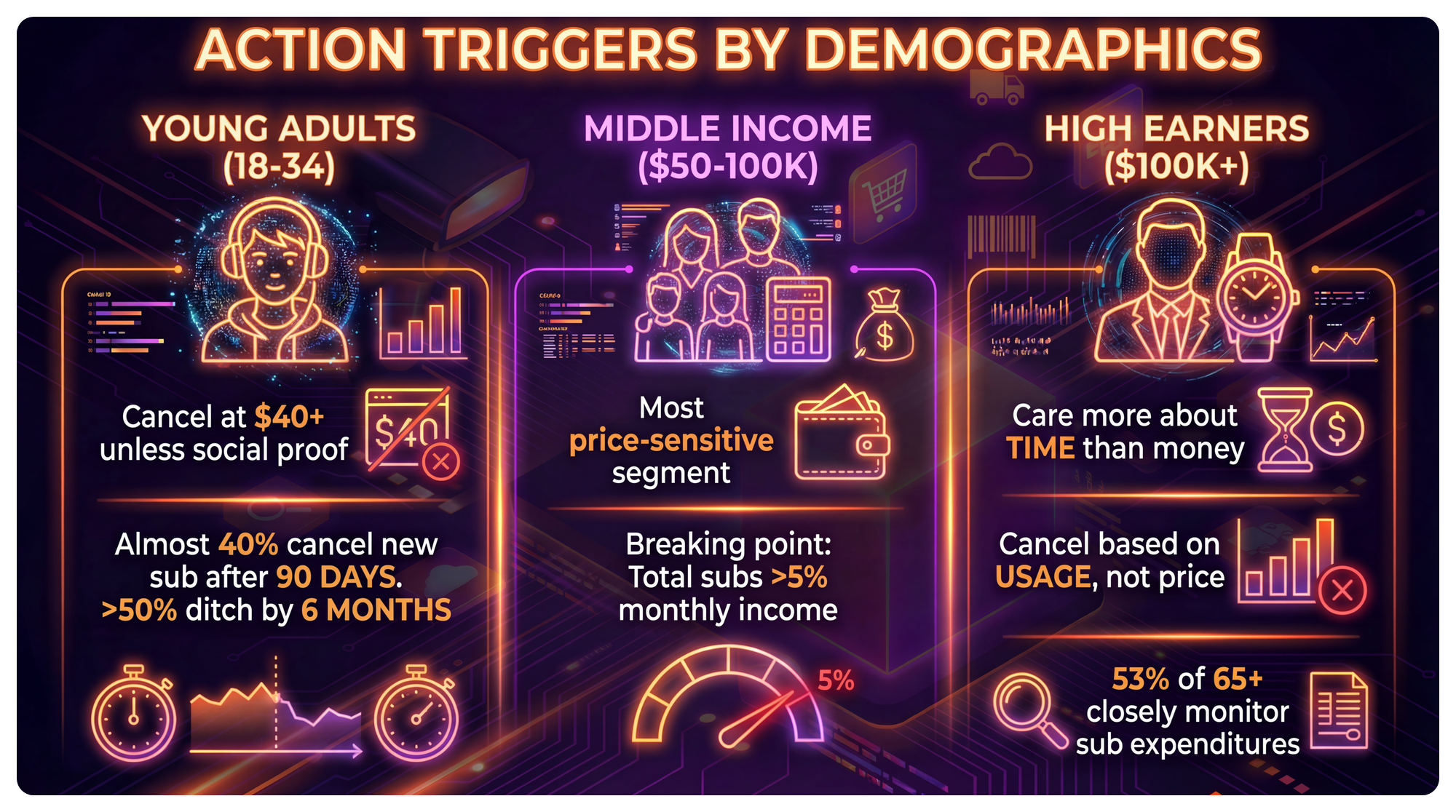
💰 Action Triggers by Demographics
Young Adults (18-34):
- Cancel at $40+ unless social proof
- Almost 40% of people cancel a new subscription service after 90 days. More than half of new subscribers ditch the service by the six-month mark
Middle Income ($50-100K):
- Most price-sensitive segment
- Breaking point: Total subscriptions >5% monthly income
High Earners ($100K+):
- Care more about TIME than money
- Cancel based on usage, not price
- 53% of those aged 65+ closely monitor their subscription expenditures.
💡 The Bottom Line Truth
Your $30 gym membership is weaponized inconvenience. Companies have data-scienced the EXACT price where cancellation effort exceeds perceived savings.
Remember: Loss aversion renders the act of canceling subscriptions psychologically burdensome, which explains why consumers frequently hesitate, even when a service no longer holds value for them.
That gym knows you're not coming back. They're counting on it. The house always wins when the game is rigged with psychology.
Thanks for reading the Monday Memo.
Until next time!
The AI Marketers
P.S. Help shape the future of this newsletter – take a short 2-minute survey so we can deliver even better AI marketing insights, prompts, and tools.
[Take Survey Here]
