
Monday Memo
A Byte of Knowledge
Fyodor Dostoevsky wrote like a man with a fever.
Broken sentences. Ideas that double back on themselves.
Emotional ruptures mid-thought.
His editors probably cringed.
But the roughness was the point.
The man who gave us Crime and Punishment and The Brothers Karamazov understood that real human thought doesn't arrive in neat paragraphs.
It stumbles. Contradicts itself. Lurches from calm to chaos without warning.
Scholars call this "learned ignorance"... choosing to sound unpolished because polish would be a lie.
And if it's good enough for one of the greatest novelists ever, it's good enough for you.
When your copy reads too smooth, too constructed, readers feel the machinery behind it.
Their guard goes up.
But when your words carry turbulence... an interruption, a raw admission, a sentence that trips over itself... something shifts.
The page starts breathing.
Your prospect stops reading marketing and starts hearing a person.
🚀 Whether you're selling a $50 supplements or a $10,000 coaching program – having these 5 'Copy Blocks' on your landing page could be the difference between crickets and an avalanche of cash flow.
Discover All 5 'Copy Blocks' Now
Something to Ponder
We Asked – AI Answered
Our Question:
"What are the real reasons 92% of adults will not follow through on their New Year's resolutions? Not the politically correct explanations, but the cold had truths most people are too afraid to face.”
AI's Answer: The Cold Truth On Why 92% Will Fail Their Resolutions
🧠 REASON #1: Present Bias (Your brain is wired to be a traitor.)
The Science: Hyperbolic discounting creates temporary preferences for small rewards that occur sooner over larger, later ones.
💡 Real Example:
- Offer $100 today vs. $120 in a week → Most take the $100
- Offer $100 in a year vs. $120 in a year + week → They'll wait
Translation for marketers: People literally cannot value future benefits properly. Their brain chemistry sabotages them before they even start.
📊 The Data Doesn't Lie:
Research by Strava (800 million user-logged activities, 2019) predicts most people give up on January 19. That's not even three weeks!
Bottom line: The dopamine hit from immediate gratification overpowers any logical long-term planning.
💭 REASON #2: False Hope Syndrome
Psychology professors Janet Polivy & Peter Herman nailed it.
People set resolutions significantly unrealistic and out of alignment with their internal view of themselves.
What's Actually Happening:
🔴 Unrealistic expectations about speed, amount, ease, and consequences
🔴 Self-change perceived as easy to achieve in unreasonably short periods
🔴 False perceptions set people up for failure before effort begins
Real talk: Your customers think they'll lose 30 pounds in 30 days because Instagram told them so. They're delusional, and deep down, they know it.

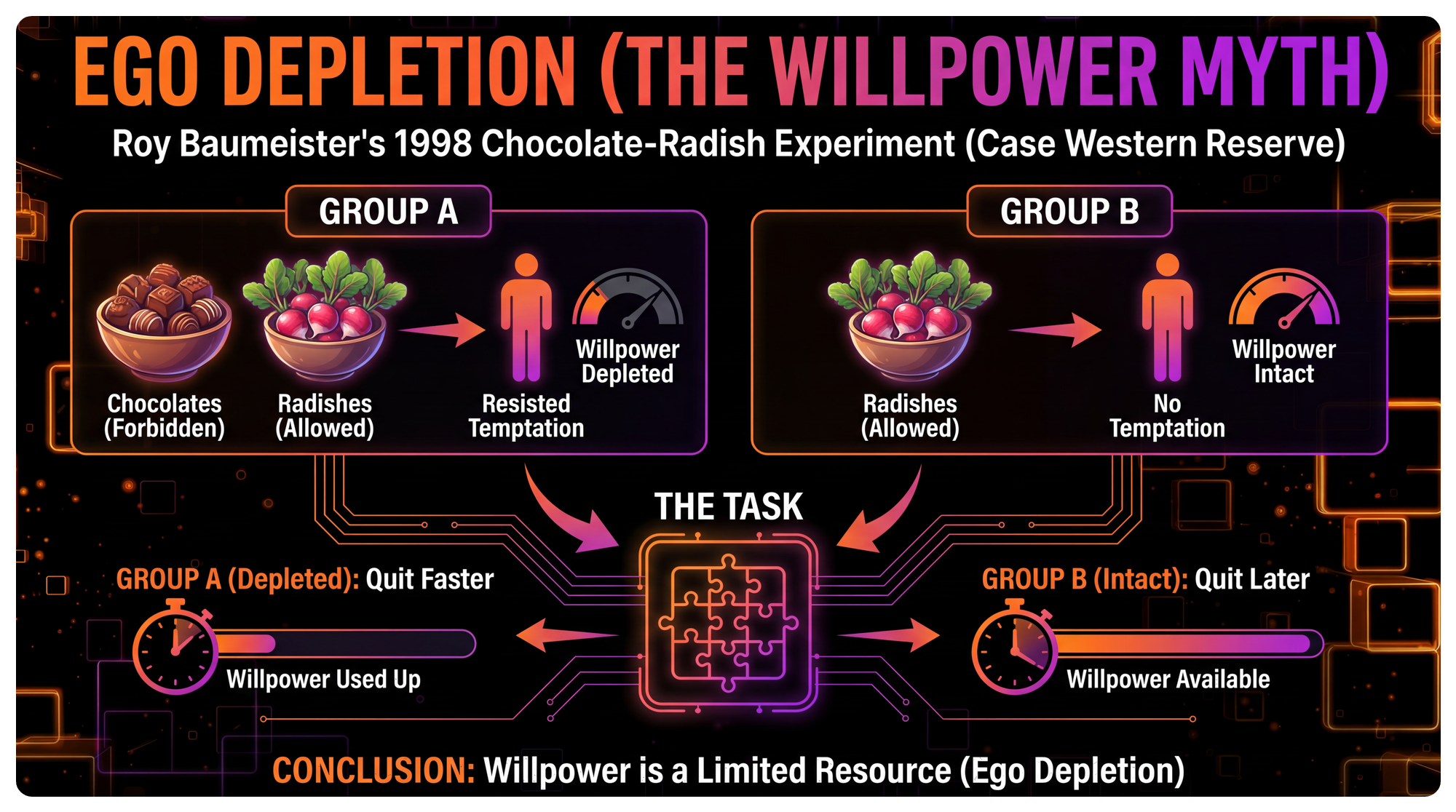
⚡ REASON #3: Ego Depletion (The Willpower Myth)
Roy Baumeister's 1998 Chocolate-Radish Experiment (Case Western Reserve)
The Setup:
- Group A: Forced to eat radishes while staring at chocolates
- Group B: Allowed to eat chocolates
- Both groups then attempted unsolvable puzzles
The Results:
- Radish eaters: Quit 50% faster
- Radish eaters: Made fewer attempts
- Why? Acts of self-control consume glucose → lower blood sugar → depleted willpower
The harsh reality: Every decision depletes the same finite resource. By noon, they're running on empty. That's why evening gym sessions fail—they've already spent their willpower on not strangling their boss.
🔥 REASON #4: The Brain's Protection Racket
Recent neuroscience shows the brain works protectively.
Key Finding: Any goals requiring substantial behavioral change will automatically be resisted
✅ Brain seeks rewards
✅ Brain avoids pain/discomfort
✅ We're evolved for 24-hour survival, NOT long-term planning
Your customers' brains literally fight against them. It's not weakness—it's 200,000 years of evolutionary programming telling them to conserve energy and avoid unnecessary effort.
Thanks for reading the Monday Memo.
Until next time!
The AI Marketers
P.S. Help shape the future of this newsletter – take a short 2-minute survey so we can deliver even better AI marketing insights, prompts, and tools.
[Take Survey Here]
