
Monday Memo (On A Tuesday)
A Byte of Knowledge
When an AI-written ad falls flat, the easy fix is to tell the model “make it more emotional.”
That gets you louder dialogue and a character crying by paragraph two, and the story stays flat underneath.
The problem is usually stakes, and stakes mean one thing:
What does this person lose if nothing changes?
“I have low testosterone and feel kind of bad” loses nothing, so there’s no story.
“I have six weeks until my daughter’s wedding and I’m scared I won’t make it through our dance” is the same man, now losing something.
Notice what that one line added: a clock running out, a room full of people watching, and a cost that lands on him personally.
Those three are what you ask the AI for, by name.
Then one last move: have the payoff mirror the fear.
Open with him dreading that dance, close with him dancing.
🚀 WATCH: How These AI Copy Bots Are Producing World-Class Sales Copy 50X Faster Than Even The "BEST" Copywriters On The Market…
(Plus… They Don't Get Sick, Miss Deadlines, Or Ask For Raises Either!)
Watch the full AI Copywriting Tell-All Video Here
Something to Ponder
We Asked – AI Answered
Our Question:
"What is Aggregation Theory - a business framework introduced by Ben Thompson? And how could it break down in the age of AI?"
AI's Answer: Ways AI Could Break Aggregation Theory 🔓
🚪 The Theory in Plain English
Before the internet, power sat with whoever owned distribution. The newspaper owned the printing press and delivery trucks, so every advertiser paid its toll.
The internet made distribution free. In 2015, Stratechery’s Ben Thompson named where the power went next: to whoever owns the customer’s front door. He called these companies aggregators.
Google ranks other people’s websites, and Facebook fills your feed with other people’s posts. Both own the place you go first, so every supplier lines up there on their terms.
The whole thing runs on one human habit... we’re lazy searchers. The #1 Google result earns a 27.6% click-through rate, 10x the #10 spot (Backlinko). Every marketer has paid that toll through SEO or ads.
AI agents don’t share the habit.
💥 How It Breaks
1. 🥇 Ranking #1 stops mattering
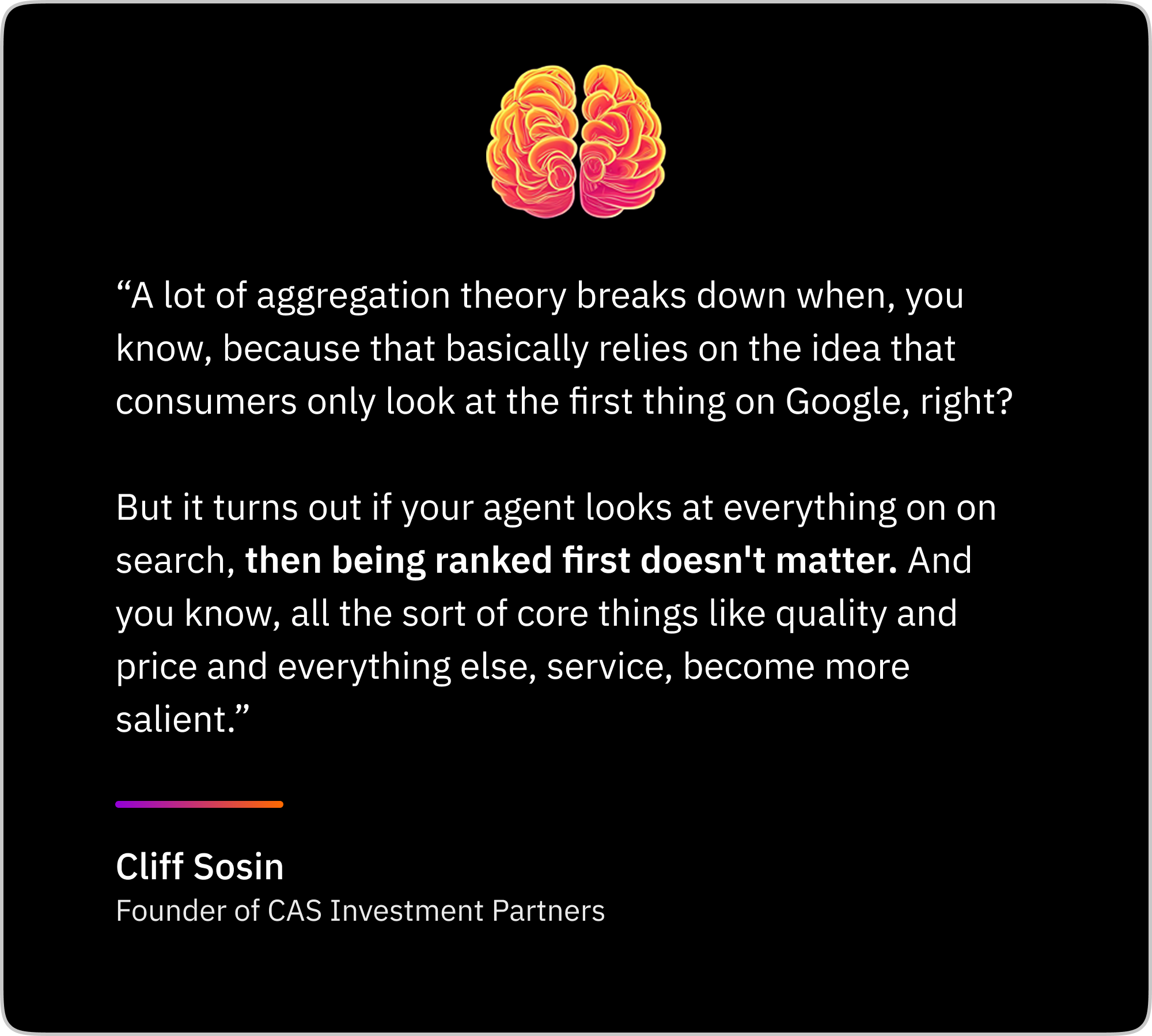
Investor Cliff Sosin said it on Invest Like the Best: “If your agent looks at everything on search, then being ranked first doesn’t matter.”
An August 2026 study pitted AI agents against real Expedia shoppers on shuffled hotel listings. Humans inspected 1.12 listings per session. Google’s Gemini 3.1 Pro inspected 5.83, and every AI model converged on the one listing no rival beat across the board.
💡 For marketers: you can’t SEO your way past a worse offer. Your offer itself becomes the ranking.
2. 🚪 The front door moves
Thompson’s first rule: an aggregator owns the direct relationship with the user. Tell an agent “buy me running shoes,” and Amazon only ever meets the bot.
Amazon sued Perplexity in November 2025 to stop its Comet agent from shopping on Amazon.
💡 For marketers: your customer’s first stop may soon be ChatGPT or Gemini, and the old gatekeeper becomes one more supplier.
3. 🔄 The traffic deal collapses
Google runs on a deal with every website:
🤝 The deal: Google reads your content for free. In return, it sends you visitors.
Every site let Google in, because blocking Google meant vanishing from search.
AI breaks Google’s half of the deal. An AI answer uses your content and keeps the visitor. Cloudflare CEO Matthew Prince says Google once read 2 pages per visitor it sent back. Cloudflare’s June 2025 data put Google at about 14 and OpenAI at 1,700.
When the deal stops paying, websites stop cooperating. Cloudflare, which says it fronts over 20% of the web, now blocks AI crawlers by default. Since September 15, 2026, that block can catch Googlebot, because Google uses one crawler for search and AI answers.
Aggregation Theory assumes suppliers can’t afford to say no. AI is giving them a reason to.
💡 For marketers: content written just to win Google traffic pays less every year. Data nobody else has gives you leverage again.
4. 🏷️ The brand tax shrinks
People pay extra for familiar names because comparing is a hassle. In a 2001 study of a price-comparison site, the three biggest-brand booksellers held a $1.72 edge on identical books.
Agents compare every seller for free, and Sosin expects them to push buyers toward the low-cost producer.
💡 For marketers: a no-name brand with better numbers can beat a famous one.
⚠️ The Twist
Thompson’s theory may simply move up one level, to whoever owns the agent. And the bots have quirks:
- Microsoft’s Magentic Marketplace test found “severe first-proposal bias,” giving fast responders a 10 to 30x edge over better offers
- Swap the model and the winner changes. One Fitbit tracker got 77% of picks from Claude Opus 4.5 and 6% from GPT-5.1
Every model update now hits like a Google algorithm update.
🎯 Your Move
✅ Make your price and specs easy for a bot to read and verify
✅ Collect third-party proof like ratings and awards
✅ Respond to inquiries fast
✅ Ask the major AI agents to shop your category, and see who wins
Thanks for reading the Monday Memo.
Until next time!
The AI Marketers
P.S. Help shape the future of this newsletter – take a short 2-minute survey so we can deliver even better AI marketing insights, prompts, and tools.
[Take Survey Here]
