
$4,000 Ad Made Them Famous. AI Beat It for $400.
Top Insights
How Dollar Shave Club's $400 AI Ad Became their Most Successful In History
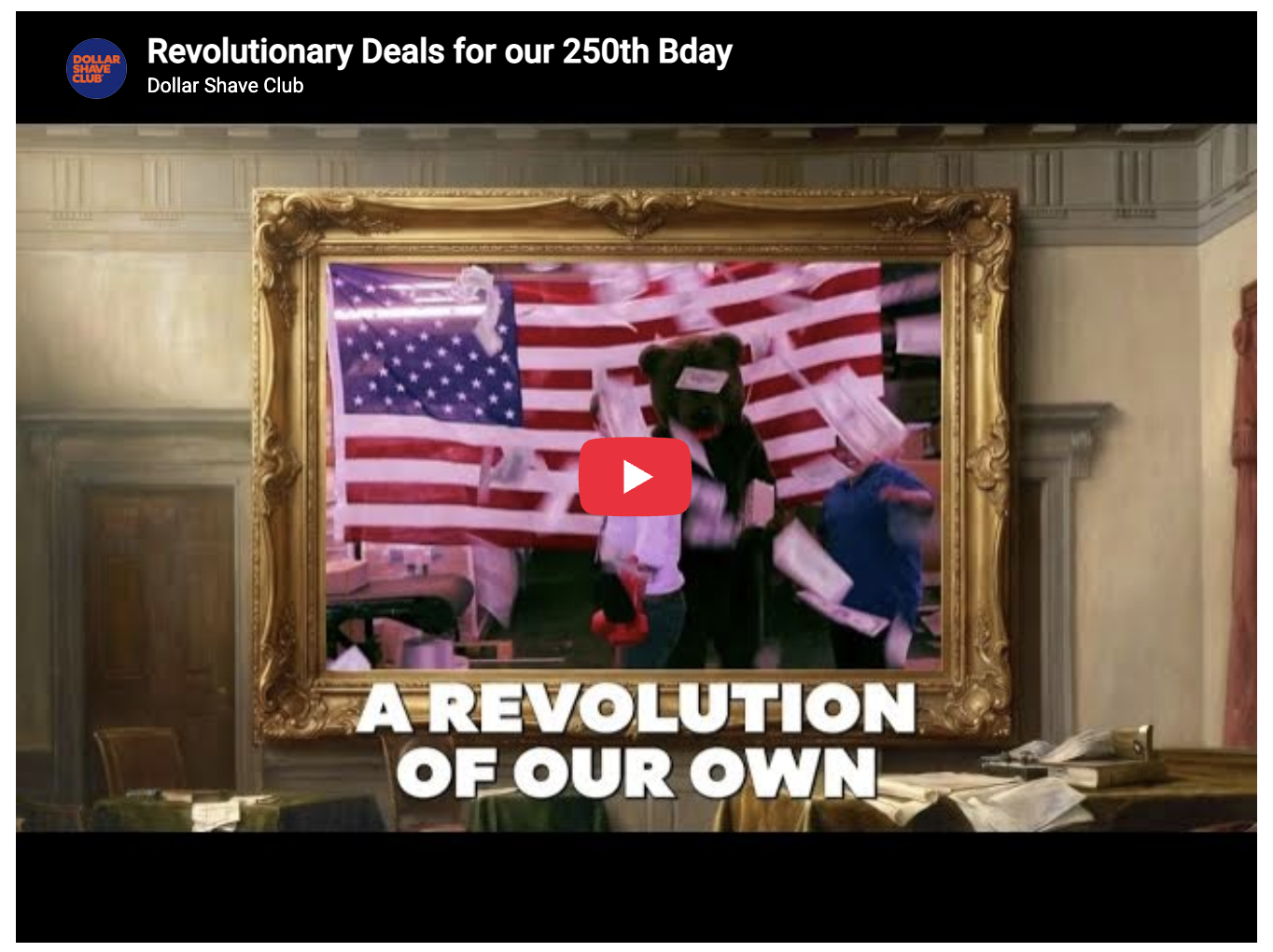
Dollar Shave Club's Chief Brand and Innovation Officer, Laura Higgins, told Marketing Dive the grooming brand is going all in on generative AI to make ads faster and cheaper. It spent $4,000 on its famous 2012 launch video... the campaign it now calls its most successful ever cost just $400.
💡 Key Insights:
- A brief can turn into a finished campaign in a week...Higgins handed "250 Years. No BS. Still Free" to her in-house team, who concepted it in three days using AI tools like Higgsfield and Claude.
- Prove your team can do it in-house and the agency loses ground...Too Short For Modeling built Dollar Shave Club's earlier AI ads, but with her team proven, Higgins expects to use the shop far less.
- Concepts too weird to film with human actors are suddenly doable...the "Danglers" ad stars truck nuts as a stand-in for male anatomy, a cartoony gag Higgins says only AI could pull off this fast and cheap.
The Chip Founder Behind a $20B NVIDIA Deal Says Your Edge in AI Is Now Human
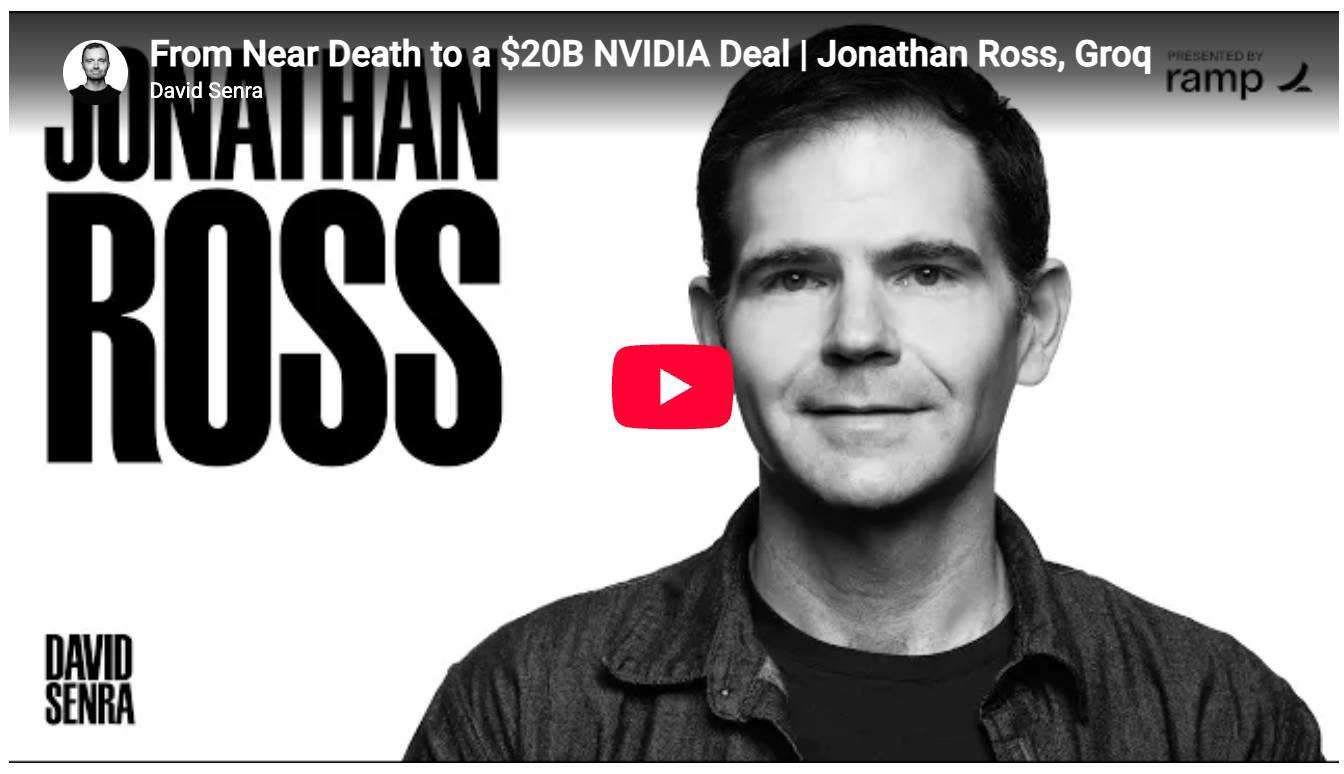
Jonathan Ross invented Google's first AI chip and founded Groq, the startup behind a reported $20 billion NVIDIA partnership. On David Senra's podcast he mostly talked hardware, but the marketer lessons sit underneath: as AI gets faster and cheaper, human skill wins.
💡 Key Insights:
- The key skill now is asking better questions...AI already holds the answers, so what you get out depends entirely on the question you put in. Value goes to whoever asks the one no one else thought of.
- People believe your product when they try it on their own problem...Ross sat through an early AI demo answering other people's questions to a silent room, then watched ChatGPT explode once each person asked their own.
- When anyone can build, taste is the new advantage...Ross's assistant now makes working apps with zero coding skill, so your edge is knowing what's worth making and what good looks like. He expects a flood of solo founders who couldn't build before.
Watch/Listen to the Full Episode
🚀 WATCH: How These AI Copy Bots Are Producing World-Class Sales Copy 50X Faster Than Even The "BEST" Copywriters On The Market…
(Plus… They Don't Get Sick, Miss Deadlines, Or Ask For Raises Either!)
Watch the full AI Copywriting Tell-All Video Here
Prompt of the Week
This Week's Feature: Founder Judgment Clone
You send the campaign up for approval and the founder kills it, over a rule that lives only in their head. So you guess and rebuild.
Ask them outright and you'll get a tidy answer that doesn't match what they actually approve. This prompt works from decisions instead: what they greenlit, rejected, regretted, and almost killed. It pulls out the real rules and grades its confidence in each.
It proves itself by predicting calls you've withheld. What comes out is a 'Founder Judgment OS' that tells you the verdict, the objections coming, and what to change to earn a yes.
FULL PROMPT:

## Objective
Build an evidence-grounded model of how **[DECISION-MAKER]** evaluates **[DECISION TYPES]** for **[COMPANY/OFFER]**. Capture the principles, trade-offs, thresholds, exceptions, and risk sensitivities needed to predict both the decision and its rationale.
## Inputs
* Decision-maker and role: **[NAME + ROLE]**
* Company, offer, and market: **[CONTEXT]**
* Decisions to model: **[CAMPAIGNS / PRICING / OFFERS / PARTNERSHIPS / HIRING / OTHER]**
* Current priorities: **[PRIORITIES]**
* Known non-negotiables: **[RULES OR “UNKNOWN”]**
* Evidence: **[APPROVED, REJECTED, REGRETTED, OR BORDERLINE DECISIONS; NOTES; DRAFTS; LINKS; FILES]**
* Current decision to evaluate, if any: **[SCENARIO OR “NONE”]**
## Operating Rules
Use supplied evidence before asking questions. Ask only one high-value question at a time—and only when the answer could materially change the model.
Probe concrete decisions rather than generic preferences. When an explanation is vague, uncover the operative rule. Use trade-off scenarios that change one important variable at a time to reveal priorities, thresholds, and exceptions.
Label every conclusion as **Observed**, **Strong Inference**, or **Tentative**. Cite the decision evidence supporting it. Never invent certainty, imitate personality, or treat an isolated preference as a universal rule.
## Calibration
1. Extract provisional rules and contradictions.
2. Test them against new past or hypothetical decisions whose outcomes are withheld until after your prediction.
3. Ask the user to grade each prediction: **correct decision and reasoning**, **correct decision but flawed reasoning**, or **incorrect**.
4. Refine until the user confirms reliability or evidence is insufficient. Report unresolved conflicts rather than forcing consistency.
## Deliverables
Produce a concise **Founder Judgment OS** containing:
* Hard constraints
* Strong preferences
* Trade-off hierarchy
* Risk sensitivities
* Approval and rejection signals
* Exceptions
* Escalation triggers
* Evidence and confidence for each rule
For any submitted decision, return:
1. Predicted decision
2. Confidence
3. Governing rules and evidence
4. Likely objections
5. Changes that could earn approval
6. Whether direct review is required
Begin by reviewing the inputs and asking the single most valuable calibration question.

Tool to Try
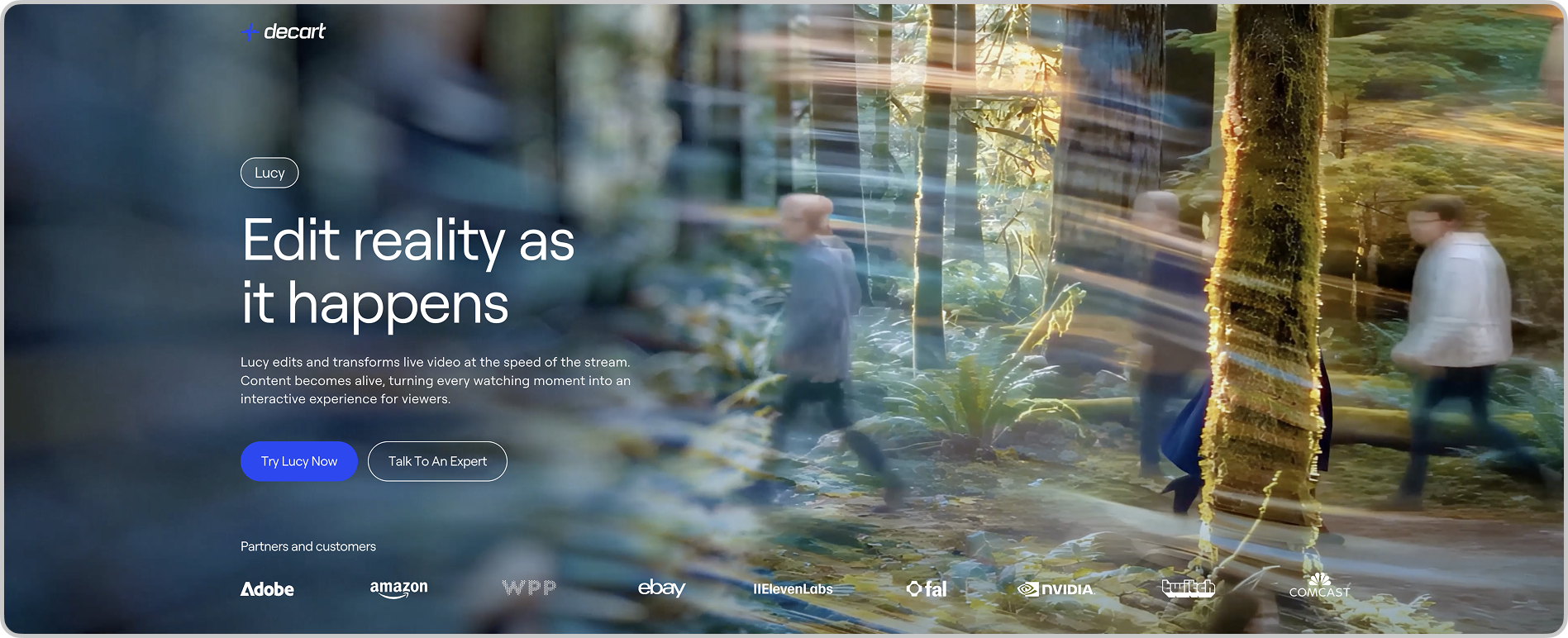
Lucy 2.5 is a live AI video model that transforms people, products, objects, effects, and entire environments while the footage is still streaming. Give it a text prompt, a reference image, or both, and it continuously regenerates the scene at 30 FPS...turning any camera feed into a programmable video canvas.
AI Tool Highlights:
🎥 Transform Live Video at 30 FPS: Lucy edits every frame as the action happens...responding to movement, lighting, and changes in the scene with near-zero latency.
🪄 Change Almost Anything on Camera: Swap someone into a new character, change their clothes, insert a product, remove an object, or replace the entire background...all with a simple prompt.
🔥 Add VFX That React to the Scene: Drop in fire, water, smoke, slime, sand, or explosions...Lucy adjusts the effects around movement, surfaces, shadows, and the surrounding environment.
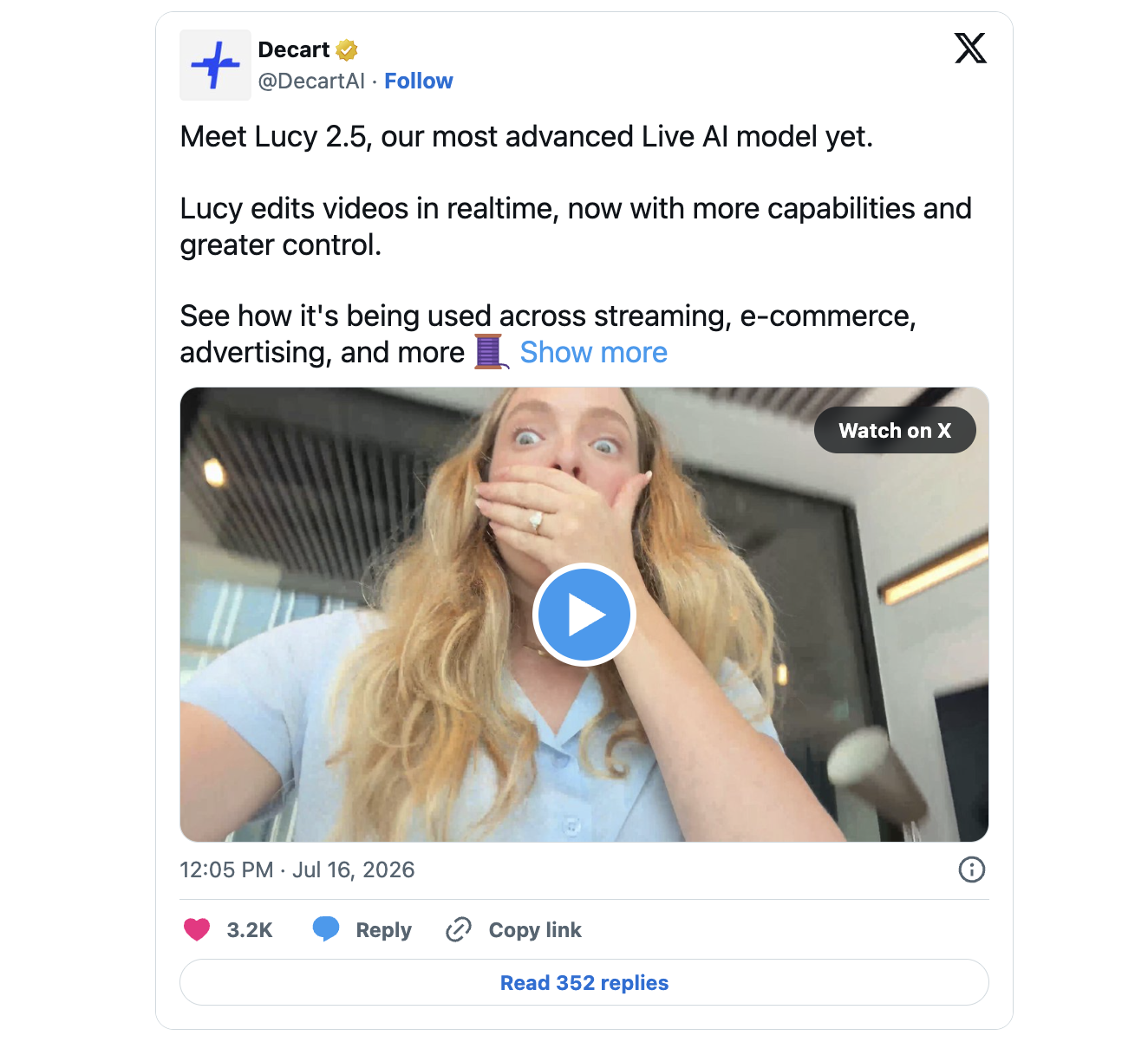
🔒 Keep Characters and Edits Consistent: Lucy’s Self-Anchoring system refreshes its visual reference as the stream continues...helping outfits, faces, textures, and character swaps stay locked in during movement.
🛍️ Turn Any Camera Into a Shopping Experience: Let customers try on clothes, place furniture inside their room, or see products inserted into a livestream...while the video keeps running.
🧩 Build Lucy Into Your Own Product: Use Decart’s JavaScript, Python, or Android SDKs...then change prompts and reference images without restarting the stream.
One More Need-to-Know News Story
B2B Growth Leaders Are 3x More Likely to Hike AI Spending
McKinsey and BCG dropped research on the same day this week and hit the same uncomfortable finding: nearly every B2B company uses AI, and most get little back. The winners rebuilt their workflows around it, and they're three times likelier to have raised AI spending by double digits this year.
📋 The Details: McKinsey's B2B Pulse Survey of nearly 4,000 buyers and sellers found 71% of high-growth companies raised AI spend by double digits this year, against 25% of laggards. BCG's marketing read stings more: 96% of CMOs say AI is remaking their function, yet only 31% have agentic workflows actually running.
🎯 Why You Need to Know: BCG flags a shift you'll feel directly: buyers now bring an AI agent to the table, and it weighs you on performance data and reviews, not marketing claims. Being seen by that agent is a long way from being recommended.
📡 Watch For: Watch for the tell McKinsey found in your own funnel: growth followed the companies that fused AI end to end, lead to renewal, and skipped those running it as scattered point tools.

Mind Fodder
Thanks for reading.
Until next time!
The AI Marketers
P.S. Help shape the future of this newsletter – take a short 2-minute survey so we can deliver even better AI marketing insights, prompts, and tools.
[Take Survey Here]
